

ニュース

China Furniture Sourcing Agent: Roles for High-End Buyers
China Furniture Sourcing Agent Roles for High-End Buyers What a China Furniture Sourcing Agent Actually Does for High-End Buyers Every finished luxury room sits on

For High-End Furniture Importers, Designers & Development Professionals Who Demand Zero Margin for Error
 A sourcing agent’s job isn’t to find furniture—it’s to protect the vision behind every piece.
The Hidden Engine Behind Seamless Luxury Furniture Sourcing
Picture this: A 12-villa resort project in Vietnam, four months from handover. The developer’s team ordered 320 custom upholstered bed frames from a furniture factory in Foshan. Two months in, photos from the factory show the wrong stitching pattern on the headboards—twice. The fix causes a six-week ripple delay. The hotel’s opening shifts. Revenue loss runs into six figures before the first guest checks in.
This isn’t a hypothetical. It’s a scenario that plays out across the luxury furniture industry more often than any developer, designer, or importer would like to admit. The painful part? It was entirely preventable.
That’s where the professional furniture sourcing agent enters—not as a middleman, not as a cost-cutting trick, but as the operational backbone that holds a complex global supply chain together. For elite furniture importers, villa developers, interior designers, and FF&E buyers, a skilled sourcing agent is less a vendor and more a risk management partner embedded inside your supply chain.
The thesis here is straightforward: a sourcing agent doesn’t just save you money. They de-risk your entire procurement process, protect your design integrity, and deliver on-time, on-spec results for the projects where failure is simply not an option.
Pain Point Deep Dive: The Silent Risks in Global Furniture Procurement
The global luxury high-end furniture market was valued at USD 38.2 billion in 2026 and is projected to reach USD 60.79 billion by 2035. Behind those numbers are thousands of high-stakes transactions where a single miscommunication between a design studio in London and a production floor in Jepara can mean the difference between a flawless five-star opening and a contractual dispute.
For high-end clients—villa owners, hotel operators, private label brands, and interior designers—the risks are categorically different from what a standard importer faces.
Design integrity is the first casualty when no one is watching the factory floor. A finish specification described as “matte champagne gold” in a design brief may be interpreted as “metallic light bronze” on a production sheet in a different language. Without someone physically validating the sample against your spec sheet, deviations compound across 200+ SKUs before anyone notices.
Timeline failures carry disproportionate financial consequences in the premium segment. A hotel opening delayed by eight weeks due to furniture backlog doesn’t just cost room revenue—it costs reputation. When the Ritz-Carlton or a boutique villa brand misses its launch date, the press coverage that follows is not the kind any operator wants.
Hidden quality issues are perhaps the most insidious risk. Defects that survive final inspection—loose joinery, inconsistent grain matching, upholstery that shows stress lines after three weeks—surface post-delivery, when your leverage over the factory is effectively zero.
A sourcing agent’s primary job is to prevent all three of these failure modes before they become your problem.

The distance between a design spec and a finished piece is where quality is either protected or lost.
Role #1: Precision Communication Management Across Cultures & Time Zones
Most procurement failures in the luxury furniture space don’t originate in the factory. They originate in translation—not just linguistic translation, but the translation of intent, tolerance, and expectation across cultures.
A design team in Dubai specifying “wenge veneer with a brushed open-pore finish” needs that detail communicated with technical precision to a factory team in Vietnam. “Open-pore finish” is not a universal factory standard term—it describes a lacquering technique where the grain texture remains tactile to the touch, as opposed to a sealed high-gloss surface. If that nuance isn’t communicated and verified in a physical sample, you’ll receive furniture that looks photogenic in a factory shot and feels wrong the moment a client runs their hand across it.
Professional sourcing agents eliminate this gap through three mechanisms. First, they translate design specifications into technical production language—not word-for-word, but concept-for-concept—matching the intent of a designer’s brief to the vocabulary a production manager and QC team actually use on the floor. Second, they bridge cultural expectations around revision cycles, urgency, and what a “confirmed sample” legally means to each party. In many Asian manufacturing cultures, agreeing to a timeline means agreeing to try—not agreeing to a contractual commitment. A seasoned agent understands this gap and structures agreements accordingly. Third, they function as a centralized communication hub. Instead of your design team emailing four factories in three time zones and tracking seven different WhatsApp threads, they deal with one expert who owns the full communication chain.
At JL&C Furniture, this centralized approach is built into every project workflow—clients who come with detailed briefs leave with confirmed samples and documented production timelines, not vague verbal commitments.
Role #2: Strategic Supplier Vetting & Relationship Management
A factory that looks excellent on Alibaba—with a polished profile, 5-star ratings, and an impressive showroom catalog—may have a production floor that operates at 60% capacity utilization, relies on seasonal subcontractors for finishing work, and can’t handle the woodgrain consistency requirements of a 150-room hotel project.
Sourcing agents know this because they’ve visited those factories. In person. Multiple times.
The vetting process a competent sourcing agent conducts before recommending a supplier to a luxury client includes on-site factory audits examining production capacity, machinery age and type (CNC vs. manual carving capability), workforce permanence, finishing facilities, and existing quality management systems. It includes cross-referencing what a factory claims to produce against what they have actually produced—requesting sample runs before any commercial order is placed.
Critically, it includes matching factory capability to project-specific requirements. A factory that excels at modern lacquered cabinetry with CNC precision is not the right supplier for hand-carved baroque-style bedroom furniture. These are different crafts, different skill sets, and different quality benchmarks. Confusing the two is a common and expensive mistake.
Beyond vetting, experienced agents maintain long-term supplier relationships that translate into real commercial advantages for their clients—priority production slots during peak season, more flexible minimum order quantities (MOQs), and the ability to escalate issues quickly when something goes wrong mid-production.
For insight on how to choose reliable Chinese furniture suppliers—including what factory audit criteria actually matter—the evaluation framework applies equally whether you’re sourcing from China, Vietnam, Indonesia, or Turkey.
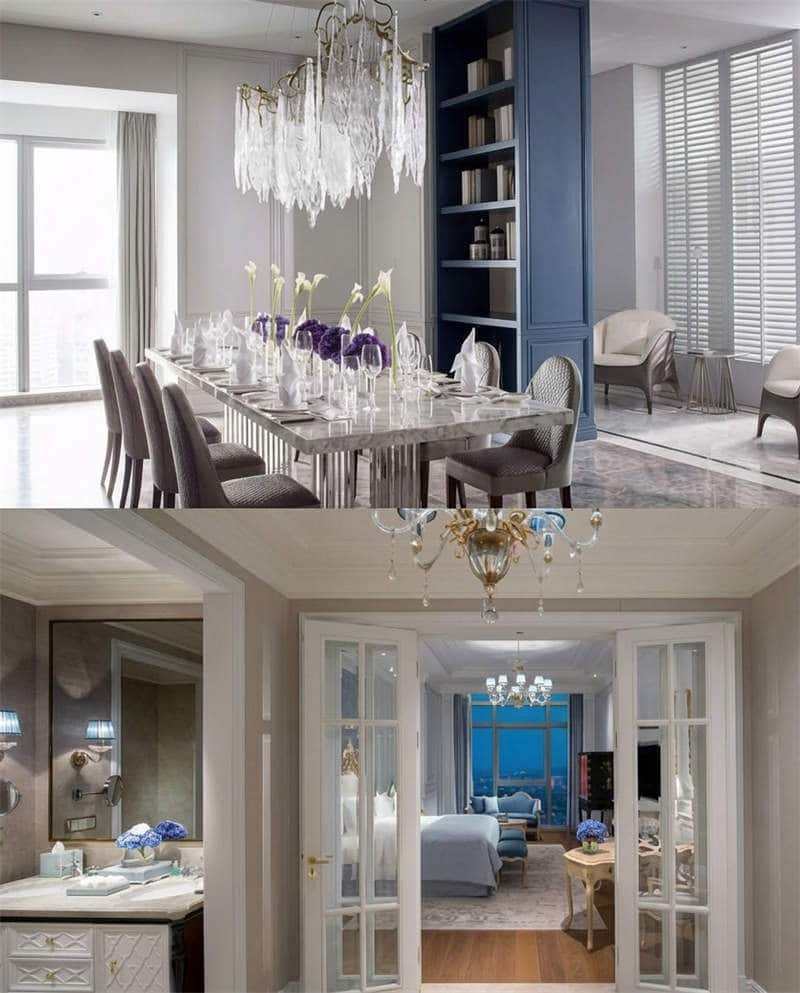
 Every piece in a space like this was specified, verified, and delivered by a supply chain that left nothing to chance.
Role #3: Proactive Production Monitoring & Milestone Verification
The most dangerous period in any custom furniture order isn’t before production starts—it’s during production, when you have limited visibility and the factory has your deposit.
Standard industry practice is for buyers to receive updates reactively: the factory sends a photo when they remember to, answers questions when asked, and flags problems when they can no longer hide them. For a single small order, this is uncomfortable. For a 300-SKU FF&E project with a fixed hotel opening date, it’s catastrophic.
Professional sourcing agents operate on a proactive monitoring model. This means weekly—sometimes bi-weekly—physical visits to the factory floor during active production runs. It means structured milestone checkpoints tied to production phases: material receipt confirmation, frame assembly sign-off, pre-finish inspection, upholstery or lacquer application review, and pre-shipment verification.
Each visit generates documented reporting: timestamped photographs of materials and work in progress, notes on any deviations from specification, and a clear status against the production timeline. Clients receive this information in real time—not as a reassurance, but as an operational tool they can share with their own project managers and contractors.
When a sourcing agent spots that a hardwood shipment arrived at the factory two grades below what was specified—as happens more often than factories admit—they can flag it, replace it, and update the client before it ever becomes a finished (and defective) piece of furniture sitting in a shipping container bound for your project site.
Role #4: Quality Assurance Tailored to Luxury Standards
AQL—Acceptance Quality Limit—is the statistical framework most commonly used in product inspection. It defines how many defects within a sample batch are acceptable before a shipment is rejected. At AQL 2.5 (a common standard for consumer goods), roughly 2.5 defective units per 100 are considered acceptable.
For a mass-market sofa sold in a big-box retailer, that’s a workable tolerance. For a custom hand-stitched leather armchair destined for a presidential villa suite, it’s an unacceptable standard. If even one of twelve armchairs in a client’s receiving room has inconsistent hand-stitching, the entire set reads as low-quality regardless of how perfect the other eleven are.
This is why luxury sourcing agents build client-specific quality protocols that go well beyond standard AQL sampling. The process begins at pre-production: the agent validates the initial sample against the client’s approved design spec—not just photographically, but physically, checking material weight, finish sheen, joinery tightness, upholstery tension, and hardware function.
In-line inspections occur at critical production stages—frame assembly, pre-finishing, and post-upholstery—when defects are still correctable without complete rework. And final inspection follows a client-specific checklist: woodgrain matching direction, finish consistency across batch, dimensional accuracy within tight tolerances, packaging integrity for fragile pieces.
For upholstered goods in particular, luxury-grade QC examines stitch count per inch, fabric alignment at seams, cushion fill density, and button depth consistency. These are not details that show up in a factory’s self-generated inspection report.
Sourcing Regions: Matching Craftsmanship to Project Needs
Not all furniture sourcing regions are created equal, and a skilled agent knows where to send each brief.
| Region | Craftsmanship Strength | Best For | Typical Lead Time |
|---|---|---|---|
| China | CNC precision, lacquer finishing, volume capacity | Modern, neoclassical, large hotel orders | 45–75 days |
| Vietnam | Solid wood joinery, skilled hand-finishing | High-end wooden pieces, residential villas | 60–90 days |
| Indonesia | Rattan, teak, artisan carving | Tropical resort aesthetics, boutique hotels | 60–90 days |
| India | Inlay work, hand-carved detail, upholstery | Bespoke decorative pieces, private clients | 75–105 days |
| Turkey | Premium upholstery, European compliance | FF&E for European markets, contract hospitality | 45–75 days |
Lead times vary by factory capacity, order complexity, and season.
A sourcing agent operating across multiple regions—rather than committing every brief to one geography—gives clients access to the right craftspeople for each specific requirement, rather than forcing every design into one factory’s capability set.
Role #5: Logistics & Compliance Orchestration for High-Value Shipments
Moving a set of hand-carved, gold-leafed console tables from a factory in Jepara to a penthouse in Dubai involves considerably more than booking a container.
Luxury furniture shipments require bespoke crating engineered to the specific dimensions and fragility profile of each piece. A 2.4-meter solid walnut dining table and a set of velvet-upholstered occasional chairs require completely different crating specifications—and the consequences of getting it wrong include surface damage, leg warping, and fabric compression marks that cannot be corrected without full reupholstery.
Beyond physical protection, high-value shipments require correct customs classification (HS codes), accurate country-of-origin documentation (relevant for tariff management, particularly post-2024 US–China trade policy shifts), material safety certifications (REACH compliance for EU markets, CARB for California), and insurance coverage commensurate with the declared value.
A sourcing agent coordinates with licensed freight forwarders, customs brokers, and last-mile white-glove delivery partners who are accustomed to handling pieces valued at $5,000–$50,000 each. They ensure that the installation team receiving the furniture at a hotel or villa site receives correctly labeled, correctly sequenced deliveries—not a container load of furniture where every piece needs to be cross-referenced against a packing list before it can be moved to the right room.
For clients navigating the challenges of importing furniture from overseas suppliers, logistics and compliance coordination is consistently one of the highest-friction points—and one of the areas where an experienced agent delivers the most measurable value.
🎬 Watch: How Professional Furniture Sourcing Actually Works

Interior Design Sourcing Explained | This video breaks down how professional sourcing agents price and structure their services—essential context for any designer or developer evaluating whether to work with one.

Every room like this represents dozens of supplier decisions, hundreds of QC checkpoints, and one coordinating professional who kept it all aligned.
Case Study: From Design Concept to Five-Star Hotel Opening—On Time
The project: a 78-key luxury resort in Bali, targeting a soft opening tied to peak travel season—a date with zero flexibility given pre-sold bookings and media coverage already confirmed.
The scope: 214 custom furniture SKUs across guest rooms, villas, the lobby, two restaurants, a pool bar, and four meeting rooms. Suppliers involved: seven factories across Indonesia and China, producing everything from rattan daybeds and teak outdoor lounge sets to lacquered wardrobes and custom upholstered dining chairs.
Six weeks into production, the interior designer made two significant material changes—swapping the original dining chair fabric for a bouclé weave and requesting a revised finish on the bedroom case goods. In a standard procurement scenario, those changes would have cascaded into delays across every affected supplier with no centralized coordination, and the original timeline would have collapsed.
The sourcing agent managed both changes as a single coordinated adjustment: communicating the revision to each relevant factory simultaneously, assessing material availability for the new bouclé specification, renegotiating partial timelines where lead time was impacted, and issuing the client a single revised milestone schedule within 48 hours of receiving the change request.
Final outcome: 98% of all SKUs arrived on-site within the confirmed delivery window. The two delayed items—oversized outdoor pieces requiring additional crating—arrived three days after the main delivery, with the installation team already informed in advance and sequencing adjusted accordingly. Zero quality rejections. The general manager’s pre-opening punch list contained no furniture-related items.
That’s not luck. That’s what structured, professional sourcing management looks like when it works.
The ROI of a Sourcing Agent: Beyond Cost Savings
Most buyers evaluate a sourcing agent through a cost lens: what’s the fee, and does it offset the price difference I might negotiate directly? This is the wrong framework entirely.
The real financial case for a professional sourcing agent in the luxury furniture segment is built on risk avoidance, not cost reduction—though cost reduction is a genuine secondary benefit.
Consider the numbers. Industry data across FF&E procurement projects consistently shows that projects managed through professional sourcing agents experience 30–50% fewer timeline delays than those managed directly by buyers without on-ground representation. Quality-related disputes—the kind that result in replacement orders, return shipping costs, and contractor delays on-site—are reduced by approximately 40%.
For a hotel project where a single week’s delay in furniture delivery pushes back the opening by ten days, and ten days of lost revenue at 60% occupancy across 100 rooms at $400/night equals $240,000 in foregone revenue, the agent’s fee—typically 5–10% of the furniture procurement value—is not a cost. It’s a hedge.
Beyond revenue protection, there’s brand equity. For a private label furniture brand, one batch of inconsistent goods shipped to a distributor who returns them can end a commercial relationship that took years to build. For an interior designer, a failed delivery on a high-profile project ends referrals before they begin.
A sourcing agent is, in the most literal sense, insurance for your project’s success—and unlike actual insurance, they’re actively working to prevent the claim rather than simply paying it out after the fact.
| Risk Category | Without Sourcing Agent | With Sourcing Agent |
|---|---|---|
| Production delays (per project) | 45–60% likelihood | 15–20% likelihood |
| Quality rejection rate | 8–15% of SKUs | Under 2% |
| Communication-driven rework | 20–30% of orders | Under 5% |
| Logistics damage claims | Higher with standard crating | Significantly lower with engineered crating |
| Brand/client dispute risk | High for private label clients | Managed via contractual protections |
 Spaces like this are the product of coordinated sourcing—every piece specified, verified, and delivered as a system, not a collection of individual orders.
How to Choose the Right Sourcing Agent for High-End Projects
Not every sourcing agent is equipped to operate at the quality tier that luxury furniture clients require. The distinction between a competent generalist agent and a specialist luxury furniture sourcing partner is significant—and getting it wrong is an expensive lesson.
The first and most important criterion is category-specific experience. A sourcing agent who handles electronics, textiles, and furniture interchangeably does not have the depth of supplier relationships, craftsmanship evaluation skills, or material knowledge that a luxury furniture project demands. You want someone who has spent years on factory floors evaluating wood moisture content, upholstery fill specifications, and lacquer cure cycles—not someone who learned to read an AQL table from a textbook.
The second criterion is in-house inspection capability. Agents who subcontract their inspections to third-party inspection companies introduce a critical gap: the inspector has no ongoing relationship with the factory, no historical context for the project, and no accountability for what happens between inspection visits. An agent with their own inspection team—people who are present throughout production, not just at final inspection—provides fundamentally different coverage.
Transparency in reporting is the third non-negotiable. A quality sourcing agent should be able to show you inspection reports, factory visit logs, production milestone updates, and material verification records for any active project—on request, at any time. If an agent is vague about what documentation they provide, that ambiguity is itself a red flag.
Finally, look for a verifiable track record with clients at your scale and complexity level. Ask for specific project references from hotel operators, villa developers, or private label brands. A sourcing agent who has managed a 500-room hotel FF&E project and a 12-villa residential development understands what high-stakes delivery actually looks like.
Teams like JL&C Furniture—operating from Shanghai with direct factory access across China and coordinating with supplier networks in Vietnam, Indonesia, and beyond—represent the integrated model: manufacturer, quality controller, and sourcing partner combined, with full visibility into manufacturing processes built into the client relationship from day one.
For anyone evaluating common mistakes importers make when buying furniture from China, the absence of a qualified agent with in-house inspection is consistently the root cause of the most painful failures.
External resources worth reviewing include the FF&E procurement framework published by Beyer Brown for hospitality projects, and the QIMA AQL reference guide for understanding how inspection sampling standards work in practice.
 Outdoor furniture for a luxury villa project—teak specification, custom cushion profile, and UV-rated fabric—all sourced and QC’d before delivery.
Glossary of Key Terms
For readers new to the procurement and manufacturing side of luxury furniture sourcing, here are the core terms used throughout this article:
AQL (Acceptance Quality Limit): A statistical sampling standard that defines the maximum number of defective items acceptable in a given batch before the batch is rejected. Standard AQL levels range from 0.065 (extremely strict) to 6.5 (permissive). Luxury projects typically require AQL 1.0 or stricter.
FF&E (Furniture, Fixtures & Equipment): The category of assets that furnish a hospitality or commercial space—everything from guest room beds and lobbies seating to lighting fixtures and artwork. FF&E procurement for hotels is a specialized discipline involving complex logistics and strict timeline management.
Tech Pack: A detailed technical document that communicates a product’s specifications to a manufacturer—including dimensions, materials, finishes, stitching patterns, hardware specifications, and tolerances.
MOQ (Minimum Order Quantity): The minimum number of units a factory will produce in a single run. For custom furniture, MOQs vary widely—from 2–5 units for bespoke pieces to 50–200 units for factory production runs.
SKU (Stock Keeping Unit): A unique identifier for each distinct product variation in an order. A 200-room hotel might require 400+ individual SKUs across all furniture categories.
CARB (California Air Resources Board): US regulation governing formaldehyde emissions from composite wood products. Compliance is required for furniture imported into US markets.
FSC Certification: Forest Stewardship Council certification confirming that wood materials originate from responsibly managed forests—increasingly required by luxury brands and sustainability-conscious developers.
よくある質問
How do sourcing agents ensure my custom furniture design is replicated exactly?
They use detailed tech packs—documents that specify every dimension, material, finish, tolerance, and hardware component—combined with pre-production sample validation on-site. Before a single production unit is manufactured, the agent physically confirms that the factory’s interpretation of your brief matches your design team’s intent. This typically involves two to three sample rounds with documented correction notes before production approval is granted.
Can a sourcing agent work directly with my interior designer or architect?
Yes, and the most effective sourcing partnerships are those where the agent is treated as a technical extension of the design team from the very beginning of the project. Agents who receive a brief late—after design decisions are already locked—have less ability to flag material availability issues, lead time constraints, or factory capability gaps that might require adjustments. Early involvement is always more efficient.
What happens if a factory misses a deadline mid-project?
A proactive sourcing agent will have identified the risk two to four weeks before the missed deadline—through milestone tracking and factory visits—and will have already initiated contingency planning. This includes assessing whether overtime production can recover the timeline, whether a backup supplier can absorb part of the order, or whether the delivery sequence can be renegotiated with the installation team to protect the critical path. The client receives all of this information in real time, not after the ship has sailed.
How do you verify the quality of handcrafted furniture, like carved wood or bespoke upholstery?
Standard AQL sampling—pulling a percentage of units at random—doesn’t capture craftsmanship quality adequately for hand-carved or bespoke upholstered pieces. Quality agents use client-approved physical benchmarks: a confirmed sample that lives at the factory throughout production, against which every piece is compared. For carved wood, evaluation criteria include carve depth consistency, edge sharpness, and surface smoothness. For upholstery, inspection covers stitch count, seam alignment, button depth, and cushion compression.
Can you source sustainable or certified materials, such as FSC-certified wood or eco-friendly finishes?
Yes. A sourcing agent with established factory relationships can verify material certifications at the point of origin—confirming FSC chain-of-custody documentation, CARB compliance for composite materials, and REACH compliance for finishes destined for European markets. This is increasingly important for luxury hotel brands with published sustainability commitments, where material sourcing must be documented and auditable.
Do you manage shipping for oversized or fragile luxury pieces?
Logistics coordination for high-value furniture requires specialized handling at every stage. This includes custom crating designed to the specific dimensions and weight distribution of each piece, climate-controlled storage where required, white-glove last-mile delivery coordinated with the installation team, and cargo insurance declared at full replacement value. For oversized pieces—dining tables over three meters, statement bed frames, monumental armoires—the logistics plan is developed before production begins, not after the piece is finished.
How do you handle design changes that occur during production?
Changes during production are common, particularly on complex projects with involved design teams. The impact of a mid-production change depends on what stage the order has reached—a fabric change is straightforward before cutting begins and costly after upholstery is complete. A sourcing agent assesses the impact immediately upon receiving a change request, communicates the cost and timeline implications to all affected suppliers, and provides the client with a revised quote and schedule before any changes are implemented. Nothing moves without client approval.
Can you support private label or brand-exclusive furniture lines?
Yes, and this requires additional protections that a specialist agent is equipped to manage. Non-disclosure agreements (NDAs) between the agent, the client, and the manufacturing factory are standard for private label work. Design files are not shared beyond the approved factory. Production is monitored to ensure exclusivity—meaning the factory is not producing the same design for other buyers. For brands with registered designs, the agent can coordinate filing in relevant manufacturing jurisdictions.
What regions do you specialize in for high-end furniture sourcing?
The primary luxury furniture sourcing regions—each with distinct strengths—are China (scale, lacquer finishing, neoclassical reproduction, CNC precision), Vietnam (solid wood joinery, hardwood availability, skilled hand-finishing), Indonesia (teak, rattan, artisan carving for tropical resort aesthetics), India (inlay work, hand-carved detail, premium upholstery), and Turkey (premium contract upholstery, European regulatory compliance). The right region for a given brief depends on the design style, material specification, project scale, and destination market requirements.
How transparent is the reporting process during production?
Clients on active projects should receive weekly production updates that include timestamped factory photographs, a status against the milestone schedule, notes on any deviations or issues identified, and confirmation of upcoming inspection dates. For large FF&E projects, a shared project tracker—updated in real time—provides continuous visibility without requiring the client to chase updates. Opacity in reporting is a red flag: if an agent can’t show you what’s happening in your factory right now, they either aren’t present or aren’t organized.
Do you help with customs clearance and import compliance?
Compliance management includes preparing the commercial invoice, packing list, bill of lading, certificate of origin, and any material certifications required by the destination country. For markets with specific import restrictions or high-tariff categories—notably the United States, European Union, and Australia—the sourcing agent coordinates with a licensed customs broker to ensure correct HS code classification and documentation before shipment, not upon arrival.
Can you assist with warehousing or just-in-time delivery for large projects?
For phased construction projects—where floors are handed over at different times, or where the installation schedule is tied to contractor milestones—just-in-time delivery coordination is essential. This means staging furniture in a bonded warehouse near the destination port, releasing deliveries in coordinated batches timed to installation windows, and labeling each consignment by room, floor, or zone so the installation team can work without a sorting operation on-site.
How do you handle disputes with suppliers over quality or delays?
The sourcing agent’s leverage in a supplier dispute comes from two sources: contractual documentation (production agreements, sample approval records, and timeline commitments that establish the factory’s obligations in writing) and the ongoing commercial relationship (a factory that wants future orders from the agent has strong incentive to resolve disputes fairly). The agent acts as the client’s advocate—communicating demands firmly, escalating as needed, and documenting all interactions to create a record that supports any claim process.
Is there a minimum order quantity for working with a sourcing agent?
No. Professional sourcing agents work with projects of all scales, from a single custom piece for a private residence to a 600-room hotel rollout. The fee structure and engagement model will differ—a percentage-based fee works well for large orders, while a fixed project fee or hourly rate may be more appropriate for smaller bespoke commissions—but the service model is not inherently dependent on order volume.
How do you ensure consistency across multiple production batches?
Batch consistency is achieved through material lot control—ensuring that hardwood for a 200-unit dining chair order comes from the same harvest lot and the same kiln-dry cycle. It requires staining and finishing benchmarks maintained at the factory throughout production. And it requires the agent to conduct inter-batch comparisons, physically placing units from different production dates side-by-side to confirm visual and structural consistency before each batch is approved for shipment.
For clients who are ready to take the risk out of their next luxury furniture sourcing project, JL&C Furniture brings 20 years of manufacturing expertise, factory-level quality control, and the operational depth to manage complex projects from brief to delivery—without the surprises.

China Furniture Sourcing Agent Roles for High-End Buyers What a China Furniture Sourcing Agent Actually Does for High-End Buyers Every finished luxury room sits on
How to Vet a China Furniture Sourcing Agent Before Signing A single curved sofa like this goes through dozens of approvals, including frame, foam, fabric

China Furniture Sourcing Agent vs Direct Factory Buying: A Strategic Guide for High-Value Buyers When one project includes 400 hotel rooms, a 20-seat marble dining

Advanced Tips to Get More from Your China Furniture Sourcing Agent Powerful Strategies for High-Performance Sourcing – Tailored for Elite Buyers, Designers & Operators Your
What Wholesale Furniture Suppliers in China Can Offer High-Value Buyers A statement luxury living room — the kind of space that begins with the right

How to Work Better With Your China Furniture Supplier After Ordering A Practical Playbook for High-End Furniture Importers, Interior Designers, FF&E Buyers, Villa Owners, Private