The gap between a supplier who elevates your portfolio and...
The gap between a supplier who elevates your portfolio and one who derails a $500,000 hotel project is rarely visible on a price sheet.
Why This Decision Is Never Just About Price
In 2024, China’s domestic furniture market was valued at $170 billion, and the country remains the world’s single largest furniture exporter — accounting for over 24% of all global wooden furniture exports, according to OEC World trade data. That volume means thousands of factories compete for your business every time you open an inquiry. For furniture distributors, showroom operators, FF&E hotel buyers, and interior designers specifying for high-end residential projects, the sheer number of options is not an advantage — it is a risk multiplier.
The difference between a supplier who consistently delivers on spec, on time, and at the quality your clients expect, and one who will cost you a hotel opening deadline and six figures in damages, is rarely apparent from a factory brochure or an Alibaba listing. It shows up in how they document production milestones. It shows up in what happens when a fabric dye lot runs short three weeks before your container is supposed to ship. It shows up in the quality of the drawing their team returns 48 hours after you submit a design brief.
This guide was written for professionals who have already felt the pain of a wrong decision — a delayed container, a color variance no one warned you about, a supplier who stopped responding mid-production — and for those who are determined to avoid it on the next project. Every factor covered here is grounded in real import scenarios, not theory.
Quick definition: A supplier vetting process is the structured series of checks a buyer conducts before placing an order — covering factory legitimacy, craftsmanship quality, production capacity, compliance certifications, pricing transparency, and communication reliability. Think of it as due diligence — the same discipline you would apply to any business partnership worth six figures.
Factor #1: Product Quality & Craftsmanship — The Foundation Everything Else Rests On
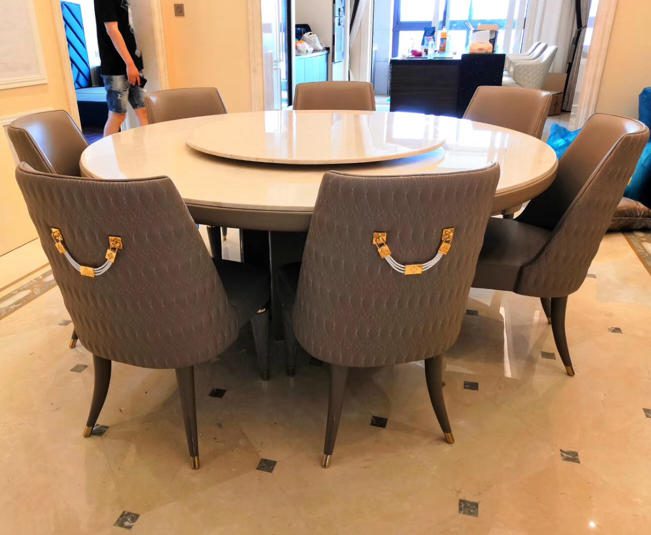
Hand-finishing details like this separate export-grade luxury suppliers from volume factories — and they are immediately visible the moment a piece enters your showroom or a client’s home.
A showroom sample is a marketing tool. It is prepared with extra care, often by senior craftspeople, specifically to win your business. The question you need answered before placing an order is not “does this sample look good?” but rather: does this level of quality appear consistently across a full container of 80, 200, or 500 units? That is where most first-time importers make their most expensive mistake, and where experienced buyers invest the most scrutiny.
Material sourcing is the foundation of everything. Ask suppliers to provide documentation — not verbal assurance — on the timber species they use (kiln-dried solid hardwood vs. finger-jointed softwood offcuts carry very different structural lifespans), the density of their MDF boards (a minimum of 720 kg/m³ is the standard for premium applications), and the foam specification for any upholstered pieces. A seat cushion built with D35 ILD 35 foam maintains its shape and support through years of commercial use. Anything below D28 on a hospitality project is a warranty claim waiting to be filed.
Joinery techniques reveal manufacturing maturity faster than any certification. Mortise-and-tenon joints, corner-block reinforcements, and eight-way hand-tied spring systems in seating frames are non-negotiable for luxury contracts. When you receive samples, flip chairs and sofas upside down — the underside construction tells you everything the front face hides. Stapled corner joints covered with fabric tell a different story than glued-and-bolted hardwood blocks.
Finishing standards are where mid-tier and luxury suppliers diverge most visibly. High-end buyers should request a minimum 5-stage lacquer process — sanding, primer coat, sealer coat, color coat, and protective topcoat — with VOC (Volatile Organic Compound — chemicals released by coatings that affect indoor air quality and are regulated in many markets) levels compliant with your destination market. Ask for the specific lacquer brand and technical data sheet, not just a verbal description of the process.
When it comes to protecting your margins through inspection, the data is unambiguous. Third-party quality inspections conducted by firms such as SGS Furniture Testing are not an optional line item — they are a margin-protection tool with a documented ROI. According to research compiled by The Inspection Company’s 2026 furniture defects guide, top-tier export-grade Chinese factories under active third-party inspection protocols consistently achieve defect rates of 1–3%. Without third-party inspections, mid-tier factories regularly deliver defect rates of 5–15%. On a $180,000 container, that is $9,000–$27,000 in replacement costs, rework labor, client relationship damage, and missed installation timelines.
Professional buyers use three inspection stages — not one. A Pre-Production Inspection (PPI) verifies that raw materials, fabric lots, and hardware match your approved specifications before a single piece is cut. A During-Production Inspection (DUPRO) catches assembly defects and finish inconsistencies while they are still correctable — not after 500 units are complete. A Pre-Shipment Inspection (PSI) provides a final check against AQL 2.5 standards (Acceptable Quality Level — an internationally recognized sampling protocol where no more than 2.5% of inspected units in a batch may be defective) before the container is sealed and cannot be reopened without customs complications.
The table below summarizes what to verify at each quality dimension during a factory visit or pre-production audit:
Quality Dimension
What to Check
Minimum Standard for Luxury
Frame Material
Species, moisture content, finger-joint ratio
Kiln-dried solid wood, MC <12%
Board Density
MDF/particle board technical data sheet
MDF ≥720 kg/m³
Foam Specification
Density and ILD rating
D35 / ILD 35 or higher
Lacquer Process
Number of coats, brand, VOC data
5-stage minimum, low-VOC formulation
Joinery Method
Corner construction, joint type
Mortise-and-tenon + glued corner blocks
Finish Consistency
AQL defect level at pre-shipment
AQL 2.5 or better
Fabric / Leather
Abrasion resistance (Martindale cycles)
≥25,000 cycles for contract-grade use
According to research from OPPEIN’s supplier verification study, approximately 92% of leading Chinese export furniture factories now hold ISO 9001:2015 certification. However, this certification confirms that a quality management system exists — it does not guarantee that your specific product passes inspection. Factory audits and product-specific inspections remain essential regardless of certification status.
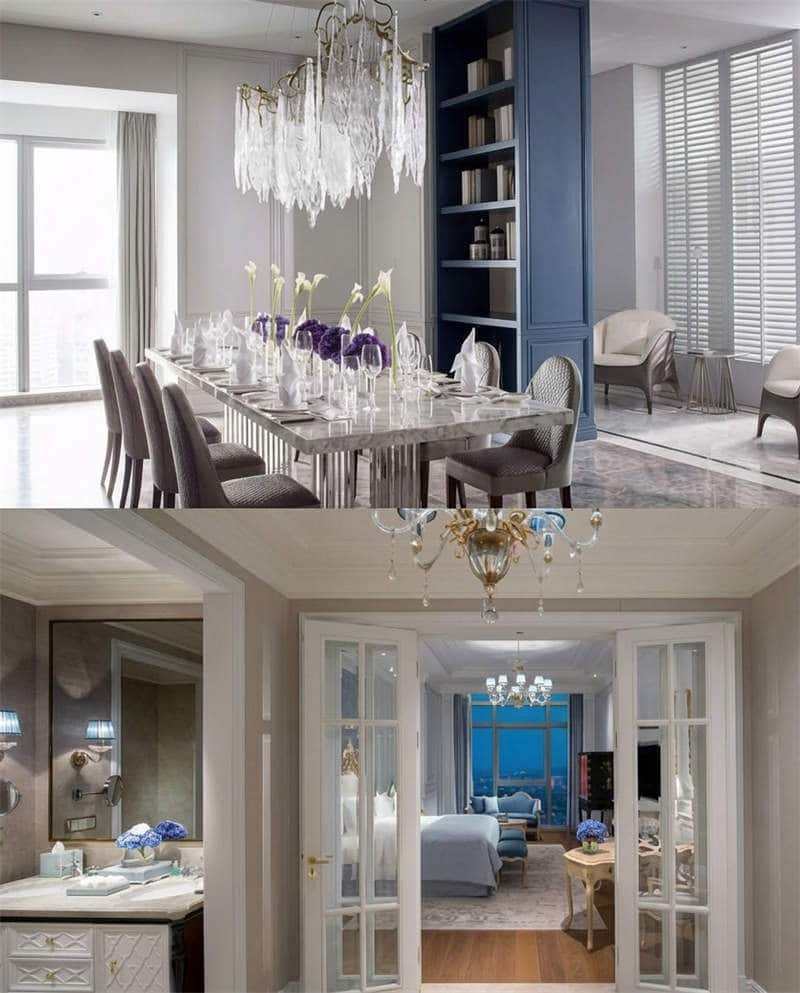
Bespoke bedroom suites like this require suppliers with CAD/CAM capability, experienced prototype teams, and designers who understand international luxury aesthetics — not just factories that use the word “custom.”
Every Chinese furniture factory will tell you they handle custom orders. The meaningful question is what level of customization they can reliably execute — and how they handle design translation from a PDF mood board or hand sketch to a production-ready technical drawing with tolerances, material call-outs, and finish specifications. That translation process is where most “custom” suppliers reveal exactly how custom they actually are.
A genuinely capable supplier offers an in-house CAD/CAM design team that can work from your technical drawings, SketchUp models, AutoCAD files, or detailed concept sketches and return dimensioned shop drawings within 3–5 business days. They offer 3D rendering support so you can present photorealistic visuals to your end client before committing to a costly prototype. They maintain a material and finish library with actual physical samples — not printed swatches or digital color chips — so you can verify color, texture, sheen level, and tactile quality against your specification. And they run prototype production with documented revision rounds and written sign-off procedures, so changes are tracked and both parties are protected.
Quick definitions: OEM vs. ODM.OEM (Original Equipment Manufacturing) means the factory produces furniture to your proprietary design specifications — you own the IP (intellectual property), and the factory executes your vision. ODM (Original Design Manufacturing) means the factory offers existing designs from their catalog that you can modify, adapt, and brand as your own. Both are valid commercial models. OEM is appropriate when you hold unique designs or are building a branded collection. ODM is appropriate when speed to market matters more than exclusivity.
MOQ (Minimum Order Quantity) — the smallest batch a factory will agree to produce — varies significantly for custom work and has a direct impact on your project feasibility. Here is what to expect from reputable export-grade suppliers:
Project Type
Typical MOQ
Production Lead Time
Standard catalog items
10–30 units
25–35 days
Minor customization (size or color change)
20–50 units
35–45 days
Fully bespoke design (new jig or mold required)
50–100 units
50–70 days
Hotel FF&E contract (multi-room, full specification)
100–500+ units
45–75 days
Villa or residential full-project sourcing
Project-based
40–60 days
To illustrate what design capability means in practice: a luxury hotel developer in the UAE needed 320 custom guestroom chairs with a specific barrel silhouette, dual-tone performance fabric, and branded embroidery on the backrest. The first supplier they approached required a 500-unit MOQ and quoted 90 days of production. After switching to a factory with a genuine in-house pattern-making and design team, the same order was produced in 58 days at a 200-unit MOQ, with a photorealistic 3D rendering approved by the client within 4 days of submitting the design brief. The price differential between the two factories was less than 6%. The design infrastructure gap was decisive.
Before committing to a production order, test the supplier’s actual design capability with a low-stakes brief. Submit a simple design request — a chair with specific dimensions, material, and finish — and observe how they respond. Do they ask the right clarifying questions about seat height, leg taper, foam firmness, and fabric repeat direction? Or do they return a catalog item that is approximately similar and call it “custom”? The quality of their questions reveals the quality of their team.
Factor #3: Manufacturing Capacity & Scalability
A supplier telling you they can handle 5,000 units per month is a claim that costs them nothing to make and costs you everything if it is wrong. Overpromising production capacity is one of the most documented causes of missed hotel opening deadlines, stalled villa completions, and broken showroom restocking cycles. The discipline here is simple: replace claims with evidence.
Verify factory floor area — a credible mid-size export furniture factory typically occupies 15,000–80,000 square meters across production and finishing areas. Anything significantly smaller claiming high-volume output warrants deeper scrutiny. Ask about the number and specialization of production lines — a factory producing both upholstered seating and solid-wood case goods needs separate lines and teams; request to see both in operation. Understand the workforce composition — for luxury furniture, a higher ratio of skilled finishers, upholsterers, and senior craftspeople to general labor indicates investment in quality that is repeatable at volume. Ask about equipment — CNC routers, beam saws, and automated edge-banding machines indicate precision and consistency; manual-only operations are appropriate for artisan single pieces but introduce unacceptable variability at contract scale.
Most importantly, ask directly: “What is your current production utilization rate, and what percentage of your capacity is already committed for the next 60 days?” A factory running at 90–95% utilization will quietly deprioritize your order the moment a larger, longer-term client pushes an urgent production run. You will hear about it only when your delivery date has already passed.
Based on data from Richart Furniture’s hotel procurement research and SNS Insider’s Hotel FF&E market analysis, here are the lead time benchmarks that experienced buyers use for project planning:
Project Complexity
Production Lead Time
Ocean Freight (China → US or EU)
Recommended Total Timeline
Stock items, no specification changes
7–15 days
20–35 days
4–7 weeks
Minor customization (color or dimension)
30–45 days
20–35 days
7–11 weeks
Standard bespoke design
45–60 days
20–35 days
10–14 weeks
Complex FF&E or multi-room hotel project
60–90 days
20–35 days
12–18 weeks
Critical planning note for hotel buyers: Add a mandatory 2–4 week buffer for any order that involves the Chinese New Year period (typically late January to mid-February), when factories close for 2–3 weeks and production queue positions for the week before the holiday are essentially unavailable. Experienced hotel procurement teams submit orders no later than October to guarantee Q1 delivery windows.
The red flags that signal a capacity risk before you commit include: a supplier who cannot provide a written production schedule with milestone dates tied to payment releases; a factory that tracks your order status primarily through WeChat messages rather than a project management system; a factory that has never previously executed a project at your scale (a factory experienced only in 50-unit runs will struggle operationally with a 500-unit hotel contract); and pricing that is 30–40% below comparable market rates — which almost always signals that quality, capacity, or both are being subsidized by shortcuts you have not yet discovered.
FSC-certified timber sourcing is no longer a “nice to have” for luxury buyers — it is a brand protection requirement enforced by hotel chains, premium retail partners, and increasingly by high-net-worth residential clients.
Certifications are not marketing boxes to tick on a supplier profile. In most key markets, they are legal barriers to entry — and for luxury hotel brands and premium retail partnerships, they are non-negotiable prerequisites. Understanding which certifications actually matter for your market, and how to verify them independently, is one of the most important practical skills a furniture buyer can develop.
The table below summarizes the core certification stack across major destination markets:
Certification
Plain-Language Meaning
Who Requires It
ISO 9001:2015
Formal quality management system — consistent documented processes and controls
Most serious B2B buyers; international hotel brands
FSC (Forest Stewardship Council)
Wood sourced from certified, responsibly managed forests — traceable from forest to product
EU markets, US hotel brands, retailers with ESG commitments
Independent lab testing for structural safety, material safety, and durability under load
Premium distributors; government and hospitality contracts
BS 5852 / CA TB 117
Fire resistance testing for upholstered furniture
UK market (BS 5852 mandatory); California contracts (CA TB 117)
OEKO-TEX Standard 100
Fabric and leather free from harmful chemicals
EU residential and hospitality contracts
EN 12520 / ANSI/BIFMA
Structural safety testing for seating under specified load conditions
EU (EN 12520); US commercial and contract seating (BIFMA)
A critical warning for US importers: CARB Phase 2 is not a voluntary standard — it is enforced federal law under the EPA TSCA Title VI framework. A container that fails CARB compliance testing at the US port of entry can be detained, subjected to destruction or re-export at the importer’s cost, and trigger an investigation into your entire import history. The cost of a CARB violation — including storage, re-export or destruction, customs penalties, and lost production time — routinely exceeds $50,000–$100,000. Ask for lab test reports from an accredited third-party laboratory (not a supplier self-declaration) for every composite wood panel used in your order, before the container is sealed. According to OPPEIN’s supplier research, approximately 72% of leading Chinese export furniture factories hold CARB Phase 2 compliance — meaning 28% do not. Those factories represent an unacceptable compliance liability for any buyer importing to the US.
On the sustainability dimension, the luxury furniture market has shifted meaningfully in the last three years. Villa developers, international hotel chains, and high-net-worth residential clients now regularly require traceable supply chains as part of their specification — proof that materials are ethically sourced, workers are fairly compensated, and environmental impact is managed and documented. A supplier holding FSC chain-of-custody certification can provide documentation tracing timber from a certified forest through every stage of production to the finished product, which supports your client’s LEED building certification application and strengthens your competitive position against local suppliers who cannot provide the same documentation.
Low-VOC finishes are increasingly specified in luxury residential contracts and are a requirement for GREENGUARD Gold certification — which is now a standard expectation in premium hospitality and LEED-compatible residential projects. Ask for the technical data sheet of any lacquer or coating system and confirm VOC levels are below 50 g/L for premium applications. For a comprehensive breakdown of each certification and which markets enforce it, the CIFF Furniture Fair’s certification guide is an authoritative reference.
Factor #5: Transparent Pricing, MOQs & Logistics Support
The factory quote you receive is the starting point of your cost model — never the ending point. Between the FOB Foshan price on a supplier’s quotation sheet and goods-in at your warehouse or project site, a furniture order typically picks up 25–65% in additional costs, according to sourcing cost research published by Sorsefu.rniture. Buyers who price their products or project bids against the factory quote alone consistently either undersell their margin or discover the shortfall only after the invoice arrives.
Quick definitions: FOB vs. DDP.FOB (Free On Board) means the supplier’s price covers production and delivery to the named port of export. Everything after the vessel departs — ocean freight, marine insurance, customs duties, port handling, broker fees, inland delivery — is your cost and your risk. DDP (Delivered Duty Paid) means the supplier manages all logistics and costs to your named delivery address, including duties. DDP simplifies your process but reduces cost transparency and typically bakes in a significant margin for the supplier’s logistics team.
Here is a real-world landed cost breakdown for a luxury upholstered dining chair with a FOB price of $320 per unit, ordered in a full 40HQ container of 200 units destined for a US importer:
Cost Component
Per Unit
Total (200 units)
% of Landed Cost
FOB Factory Price
$320.00
$64,000
57.8%
Ocean Freight (40HQ, China → US West Coast)
$27.50
$5,500
4.9%
Marine Insurance (1% of cargo value)
$3.20
$640
0.6%
US Standard Import Duty (HS 9401.61)
$19.20
$3,840
3.5%
Additional Tariff (China-origin, current rate)
$32.00
$6,400
5.8%
Port Handling + Customs Broker
$7.50
$1,500
1.4%
Third-Party Inspection (amortized per unit)
$2.50
$500
0.5%
Inland Freight (port → warehouse or site)
$12.00
$2,400
2.2%
Storage / Dwell Risk Buffer
$6.00
$1,200
1.1%
Currency and Wire Transfer Fees
$2.10
$420
0.4%
Contingency Buffer (5%)
$21.60
$4,320
3.9%
True Landed Cost per Unit
$453.60
$90,720
100%
The FOB quote of $320 becomes a landed cost of $453.60 — a 42% increase before your retail or project markup. This is not an exceptional scenario. It is the standard reality of furniture importing that price-focused buyers consistently underestimate on their first and second orders.
On tariffs: As of 2025, US tariff policy on Chinese furniture has undergone revisions. A temporary tariff reduction was announced in May 2025, suspending 24 percentage points of the previously imposed additional duties for a 90-day negotiation period. The current applicable rate for Chinese-origin furniture should be verified at the time of your order using the Tariff Tools furniture duty calculator and confirmed with your customs broker against your specific HS code, since rates are subject to change by executive order with limited advance notice.
Negotiating on value, not just price. Experienced importers use several levers that price-focused negotiators miss. A volume commitment with quarterly draw-down — committing to 6 containers over 12 months rather than negotiating each order independently — typically yields price reductions of 5–10% and, more importantly, secures priority production slots in the factory’s schedule. Packaging optimization — working with the supplier to design packaging that maximizes container cube utilization — can recover 8–15% of wasted container space you are already paying for. Payment term evolution — shifting from 30% deposit / 70% before shipment on your first order to 30% deposit / 70% upon presentation of original shipping documents on your third or fourth order — improves your cash flow without increasing your supplier’s risk. And for custom designs requiring new jigs or molds, negotiating to amortize tooling costs across two orders rather than charging them upfront protects your budget on the initial production run.
Logistics support is a supplier quality indicator. A supplier who hands your shipment to a freight forwarder at the factory gate and considers their job done is leaving you to manage the most operationally complex part of the transaction entirely on your own. The best Chinese furniture suppliers — including the team at JL&C Furniture — coordinate container load planning, prepare export documentation accurately, schedule third-party inspections, and maintain direct relationships with freight forwarders experienced in furniture-specific logistics requirements including ISPM 15 wood packaging treatment, correct HS code classification, and CARB documentation packaging. This coordination reduces administrative burden on your team and materially lowers the probability of customs delays caused by documentation errors — which, at major US ports, run an average of 7–11 days per incident.
The Hidden Factor: Communication Quality & Partnership Reliability
A quality defect in a production run can be fixed. A communication breakdown — one that results in the wrong fabric being cut across 300 chairs, or a critical dimension being misunderstood between a design file and the factory floor — can cost you everything that cannot be reversed: an installation deadline, a hotel opening date, a client relationship. In a survey of international B2B furniture importers, communication failures consistently rank as the #1 cause of costly sourcing mistakes — ahead of quality defects and logistics failures combined. When your supplier is 8–16 time zones away and operates primarily in Mandarin, communication infrastructure is a core selection criterion, not a soft preference.
What to look for in a supplier’s communication setup: a dedicated English-speaking account manager assigned to your account — not a rotating contact you have to re-brief each week; written inquiry responses within 4–8 business hours of your query during their business day; proactive production updates with photo and video documentation at each milestone, rather than silence until a problem forces a conversation; willingness to use structured communication tools — shared specification documents, production tracking sheets, or project management platforms — rather than managing a $200,000 order through fragmented message threads; and a clear escalation path so you know exactly who to contact when a decision is time-sensitive and your account manager is unavailable.
Suppliers experienced with European, North American, and Middle Eastern buyers understand that a deadline means a deadline — not a target or an aspiration. They understand that design approval requires written documentation, not an assumed “yes” from a video call that was partially lost to translation. They have adapted their business hours to create overlap with your working day. These factors seem abstract until a container of incorrectly specified furniture arrives three weeks before a hotel opening, and the only evidence you have that the supplier acknowledged the correct specification is a WeChat message from four months ago.
Red flag: If the primary source of your production status updates is informal factory floor photos sent without context by someone you have never been introduced to — rather than scheduled milestone reports from a named project manager who understands your complete specification — escalate your engagement or reconsider the relationship before the production run is complete.
How to Vet & Verify: The 15-Point Supplier Framework
Before committing to a first production order with any Chinese supplier — regardless of how impressive their showroom, how competitive their pricing, or how enthusiastic their sales communication — complete this verification framework. It requires 3–5 business days and will save you from the category of mistakes that cost experienced buyers $50,000–$200,000 per incident.
#
Verification Step
Method
Pass Signal
1
Business license authenticity
Request Chinese Business License; cross-verify on SAMR registry
Active registration; legal name matches contract entity
2
Export license and registration
Request customs export registration number
Matches the furniture product categories you are ordering
3
Factory vs. trading company
Request factory registration documents; ask for floor plan
Direct factory preferred for cost transparency and control
4
Live factory video tour
Request real-time video call walkthrough — not a recorded promotional video
Working production equipment visible; not a showroom-only facility
5
Production capacity documentation
Monthly unit output by product category, in writing
Documented figures; not verbal claims
6
International client references
Minimum 3 independent references with contact details
Contact them directly; ask about lead time variance and defect rate
7
ISO 9001 certificate
Request original certificate with expiry date
Verify via issuing certification body website
8
FSC / CARB / TSCA certification
Original certificates; verify on issuing body registries
Matches the specific product categories in your order
9
Third-party test reports
SGS, Intertek, or Bureau Veritas product-specific test reports
Product-specific tests — not generic category certificates
10
Physical sample evaluation
Independently assessed against your full specification
AQL 2.5 pass or better across all evaluated dimensions
11
Design capability test
Submit a structured design brief; evaluate turnaround and accuracy
Dimensioned shop drawings returned within 3–5 business days
12
Communication quality test
Submit a structured written inquiry; evaluate response speed and accuracy
Complete, accurate response within 8 hours
13
Export history
Request summary of export volume and destination markets for prior 2 years
Consistent export activity; diversified client base
14
NDA acceptance
Submit your standard NDA before sharing any design files
Signed without negotiation delays
15
Purchase agreement acceptance
Propose a formal contract including penalty clauses for delays and defects
Accepts penalty clauses without exclusion
For high-value projects — hotel FF&E contracts, multi-villa developments, or large showroom sourcing rounds — supplement this checklist with a formal on-site factory audit conducted by a specialist third-party firm. SGS, Bureau Veritas, and QIMA all offer furniture factory audit services that produce written reports. These reports serve two functions: they provide an objective quality baseline before production begins, and they create legal documentation that protects you in the event of a contractual dispute. The Sofeast importer checklist for China sourcing is a well-structured reference for pre-qualification and ongoing order management protocols.
Real-World Failures — and What Elite Suppliers Do Differently
The four failures described below are drawn from documented import scenarios, not hypothetical examples. They represent the most common and most costly categories of sourcing mistakes in the luxury furniture segment.
Delivery delays that miss installation windows. A 200-room hotel project in Singapore required custom guestroom furniture with a firm delivery window of 18 weeks from order confirmation to on-site delivery. The original supplier confirmed the timeline, then began revising it at week 10 — first to 20 weeks, then 24 weeks, with no explanation beyond “production delays.” The hotel opening was deferred by 6 weeks at an estimated cost of $380,000 in lost room revenue and repositioned advance bookings. Elite suppliers prevent this by structuring binding production schedules with milestone payments — installments released upon verified completion of raw material cutting, frame assembly, finishing, and packing. Tying payment release to milestone delivery aligns the supplier’s financial incentive precisely with your timeline.
Color and material variance across a production run. A distributor in Australia received 180 dining chairs across three production runs over 10 weeks. Units from the third run had a visible fabric color variance — subtle enough to pass individual AQL inspection, but unmistakable when chairs were placed side by side in a restaurant dining room. Twelve chairs were rejected and had to be reordered at the distributor’s cost. Elite suppliers prevent this through color lot management — purchasing the entire fabric volume for a project from a single dye lot before production begins — combined with in-line color matching against an approved master sample at three production checkpoints, and photographic documentation shared with the buyer before the container is loaded.
Customs detention caused by documentation errors. A US-based importer had a 40HQ container held at the Port of Los Angeles for 11 days due to an incorrect HS code on the commercial invoice — a $15,200 storage, customs broker, and penalty cost on top of a project deadline missed by two weeks and a client relationship severely strained. Elite suppliers prevent this by maintaining internal customs documentation teams experienced in destination-market requirements, including correct HS code classification, accurate country-of-origin certificates, CARB compliance documentation packaged with the shipment, and conformity with CBP’s entry documentation standards.
Assembly defects discovered on site. A villa developer in Dubai received a full 24-bedroom furniture package including bespoke wardrobes with pre-drilled hinge holes that did not align — a factory drilling coordinate error that made field assembly impossible without on-site carpentry intervention across all 24 suites. The remediation cost — carpenter time, timeline extension, client management — exceeded $28,000. Elite suppliers prevent this by pre-assembling a representative 10% of each SKU at the factory before packing begins, with photographic documentation of completed assembly, and maintaining a 48–72 hour quality hold after packing during which any identified assembly defect triggers a production review before additional containers are loaded.
🎬 Watch: How to Source High-Quality Furniture in China Without Getting Burned
This video covers the most common sourcing mistakes buyers make in China — from misleading showroom samples to hidden cost structures, factory legitimacy red flags, and timeline miscalculations. Essential viewing before your next sourcing trip or remote factory engagement.
From Transaction to Strategic Manufacturing Partnership
The difference between a furniture supplier and a strategic manufacturing partner shows up in project outcomes like this — where every piece, across every room, meets the specification precisely and arrives on schedule.
The most successful furniture distributors, FF&E buyers, showroom operators, and interior design firms operating at scale have one thing in common: they treat their top supplier relationships as strategic alliances, not repeated one-off transactions. This distinction is worth articulating because it changes the entire dynamic of how the supplier allocates resources, prioritizes production slots, and responds when an unexpected problem requires a decision within 24 hours.
A transactional relationship produces transactional behavior — minimum compliance, no proactive problem-solving, and no priority when the factory is running at full capacity and must choose which client gets the next available production slot. A partnership produces the opposite: early warnings when materials are delayed, priority position in the production queue during peak periods, design collaboration on upcoming projects before you have finalized your brief, and a supplier team that is invested in your success because they understand where your projects fit in your business and in theirs.
Building that kind of relationship requires three disciplines. First, share your forward project pipeline — not just your current order. When a supplier can see that you have three hotel projects over the next 18 months, they plan capacity accordingly and treat your account as a long-term asset. Second, involve your supplier early in the design process — not just at the point of issuing a finished specification brief. Early involvement allows the supplier to flag material availability, recommend construction approaches that improve durability or reduce cost, and identify potential timeline risks before they become problems. Third, visit the factory — ideally once per year. The working familiarity that develops from face-to-face relationships with the production team, the finishing manager, and the project coordinator shortens revision cycles, eliminates the ambiguity that generates errors, and creates accountability that remote communication alone cannot replicate.
If you are evaluating a new supplier, begin with a defined pilot order — a single product category, 20–50 units, with a clear specification and explicit quality criteria. Conduct a pre-shipment inspection on 100% of the pilot order (not the standard sampling rate). Document every outcome against your criteria: delivery timeline vs. promised, defect rate, communication quality, and customs documentation accuracy. Score the supplier objectively before deciding to scale the relationship. This approach protects your most important existing client relationships while generating the real-world evidence you need to make a confident long-term commitment.
JL&C Furniture manufactures and exports high-end residential and hospitality furniture to distributors, interior design firms, and hotel developers across North America, Europe, the Middle East, and Southeast Asia. The factory supports OEM and ODM projects with in-house design and CAD/CAM capability, holds FSC and ISO 9001 certifications, assigns a dedicated English-speaking project manager to every account, and has an established track record with hotel FF&E contracts at the 200–500 room scale and multi-villa residential projects.
If you are preparing for a new hotel project, a showroom sourcing round, or a private villa development — contact the JL&C Furniture team directly to request a factory capability profile, current lead time schedule, and a customized quotation. For buyers who want to explore completed project references before initiating contact, the JL&C custom villa furniture portfolio documents the specification depth, finish quality, and scale of recent residential and hospitality projects.
Glossary of Key Sourcing Terms
The following definitions are provided for buyers at any level of import experience. Mastering this vocabulary allows you to write better briefs, ask better questions, and evaluate supplier responses with greater precision.
Term
Plain-Language Definition
Practical Example
FOB (Free On Board)
Price includes production and delivery to the named export port. All costs after vessel departure are the buyer’s responsibility.
“FOB Guangzhou” = price covers delivery to Guangzhou port only
DDP (Delivered Duty Paid)
Supplier covers all logistics costs — freight, duties, and delivery to the buyer’s named address.
“DDP Dubai” = price to your warehouse door, all costs included
MOQ (Minimum Order Quantity)
The smallest batch a factory will produce for a given product or custom design.
MOQ of 50 units for a bespoke dining chair
AQL (Acceptable Quality Level)
International sampling standard defining the maximum acceptable defect percentage in a production batch. AQL 2.5 = maximum 2.5% defective units allowed.
AQL 2.5 is the industry standard for luxury furniture contracts
CARB Phase 2
US federal regulation (enforced by the EPA under TSCA Title VI) limiting formaldehyde emissions from composite wood products.
Mandatory for all composite wood furniture imported into the US
FSC (Forest Stewardship Council)
Certification verifying that timber was sourced from forests managed according to environmental and social standards.
Required by major hotel brands and EU retail chains
OEM
Original Equipment Manufacturing — factory produces furniture to the buyer’s proprietary design specification. Buyer retains IP ownership.
You design a chair; the factory builds it exactly to your drawings
ODM
Original Design Manufacturing — factory provides existing designs the buyer can modify and brand.
Faster market entry; less upfront design investment
Section 301 Tariff
Additional US tariff applied to Chinese-origin goods as a trade policy measure, on top of standard MFN duty rates.
Applied to most Chinese furniture categories entering the US
DUPRO
During Production Inspection — third-party quality check conducted while production is in progress, before all units are completed.
Catches assembly errors while correction is still possible
Martindale Cycles
Standardized test measuring fabric abrasion resistance. Higher cycle count = longer fabric lifespan under use conditions.
Furniture, Fixtures & Equipment — the movable specification items in hospitality, commercial, and residential interior projects.
Hotel guestroom chairs, beds, and case goods are FF&E
Low-VOC
Coatings or finishes formulated to minimize Volatile Organic Compound off-gassing — important for indoor air quality and LEED certification.
Specified in luxury residential and GREENGUARD-compliant contracts
NNN Agreement
Non-Disclosure, Non-Use, Non-Circumvention — a legally stronger instrument than a standard NDA for use under Chinese law. Protects your designs and client relationships from being used or shared without your authorization.
Sign before sharing any proprietary drawings with a Chinese factory
ISPM 15
International phytosanitary standard requiring heat treatment of wood packaging materials to prevent pest transmission across borders.
Required on all wooden pallets and crating used in international shipments
HS Code
Harmonized System Code — the international product classification number that determines import duty rates at customs.
HS 9401.61 = upholstered wooden-frame seats for domestic use
FAQ: 12 Questions Furniture Buyers Ask Before Sourcing From China
1. How do I verify the quality of a Chinese furniture supplier before placing an order?
Request physical production samples — not showroom display pieces — and assess them against your actual specification: dimensions, foam density, frame construction, joint type, finish quality, and fabric performance. Supplement the sample review with a pre-production factory audit conducted by an independent third party such as SGS or Intertek, and ask for the most recent third-party inspection reports the supplier has received for similar products. Verification through documentation is always more reliable than verification through a sales visit alone.
2. What is a realistic MOQ for custom luxury furniture from China?
For standard catalog items with minor changes (color, size), MOQs typically range from 20–50 units. For fully bespoke designs requiring new jigs or molds, most reputable factories require 50–100 units to justify the tooling investment. Hotel FF&E contracts and villa development projects are frequently evaluated on a total project-value basis, with per-item MOQ flexibility tied to overall order size rather than individual SKU minimums.
3. Can Chinese suppliers work from my design drawings or 3D files?
Yes — top-tier suppliers maintain in-house CAD/CAM teams capable of interpreting AutoCAD technical drawings, SketchUp models, Revit files, and detailed design briefs. The critical variable is turnaround accuracy and speed. Before committing an order, test the supplier by submitting a sample brief and evaluating the quality and completeness of their response drawing within 3–5 business days.
4. How long does a full container of custom furniture take from order to delivery?
For standard custom orders with an approved sample, allow 45–60 days production plus 20–35 days ocean freight for a total of 10–14 weeks to North America or Europe. For complex bespoke or large-scale hotel FF&E, budget 12–18 weeks. Always add a buffer around Chinese New Year and confirm the factory’s current production queue position before locking in your project timeline.
5. Are Chinese furniture factories able to meet international fire and safety standards?
Leading export-grade factories produce furniture tested and certified to BS 5852 (UK), CA TB 117 (California), and EN 1021 (EU). Request the official test report from an accredited laboratory — specifying the exact fabric, foam, and frame combination tested — and confirm it matches your order specification precisely. A generic fire test certificate for a different product configuration provides no legal protection.
6. Which certifications should I prioritize when selecting a supplier?
At minimum: ISO 9001:2015 for quality management, CARB Phase 2/EPA TSCA Title VI for any US-bound shipments involving composite wood, FSC for markets with sustainable sourcing requirements, and SGS or Intertek test reports for the specific furniture categories you are ordering. For European markets, add EN 12520 structural testing for seating. For upholstered goods, OEKO-TEX Standard 100 verifies fabric chemical safety.
7. How do I handle quality issues discovered after delivery?
Before an issue occurs, ensure your purchase agreement specifies: the maximum acceptable defect rate (AQL 2.5 is the luxury standard), the supplier’s obligation to replace defective units within a defined timeline (20–30 business days is typical), which party bears the cost of replacement production and shipping, and what photographic and inspection evidence is required to trigger the warranty claim. Without these terms in writing and signed before production begins, your leverage after delivery is essentially zero.
8. Can I visit the factory in China before placing an order?
Reputable suppliers actively welcome client visits and will assist with scheduling and logistics coordination for trips to their facility. In-person visits are particularly valuable for evaluating production infrastructure, meeting the project management team you will work with daily, and viewing current production for similar clients. Most serious B2B buyers at the hotel or multi-villa project scale conduct at least one factory visit before committing to a significant order. If an in-person visit is not feasible, a live video call factory tour — conducted in real time, not via a pre-recorded walkthrough — is the next best option.
9. Can suppliers provide custom branded packaging for retail or showroom delivery?
Yes. Export-grade suppliers offer custom outer cartons with your branding, protective foam inserts sized to your specific products, multi-language assembly instructions, flat-pack solutions optimized for specific retail and showroom formats, and branded hang tags or labeling. Packaging specifications should be discussed and confirmed at the same time as product specifications — late-stage packaging changes can delay production completion and add unexpected costs.
10. How do I manage communication and decision-making across time zones?
Choose a supplier that assigns a dedicated English-speaking account manager to your account, establishes a clear communication schedule, and responds to written inquiries within 8 hours of their business day. Require that all specification changes, design approvals, and production milestone confirmations be documented in writing — email or a shared project document — not acknowledged verbally on a video call and then managed informally. The paper trail protects both parties when a question arises three months after a decision was made.
11. What payment terms are standard and how do I protect myself?
The standard structure for a first order is 30% deposit upon order confirmation, 70% T/T (Telegraphic Transfer — a direct bank-to-bank wire transfer) before shipment. For orders above $100,000, consider using a Letter of Credit (L/C), which provides bank-mediated security that payment is released only upon presentation of specified shipping documents. Never pay 100% upfront, regardless of how competitive the price or how persuasive the urgency. As the relationship matures across 2–3 successful orders, negotiate shifting the 70% balance to upon presentation of the original Bill of Lading, which extends your cash flow window by 5–15 days.
12. Can I private label or co-develop exclusive designs with a Chinese manufacturer, and how do I protect my IP?
Absolutely — most export-grade manufacturers offer both OEM and ODM services. Before sharing any proprietary design files, concept drawings, or client briefs, have the supplier sign an NNN Agreement (Non-Disclosure, Non-Use, Non-Circumvention) — a legally stronger instrument than a standard NDA under Chinese law. For maximum protection, register your designs with the China National Intellectual Property Administration (CNIPA) before sharing them with any factory. JL&C Furniture supports OEM and ODM projects with NDA signing as a standard part of the onboarding process.
China Furniture Sourcing Agent Roles for High-End Buyers What a China Furniture Sourcing Agent Actually Does for High-End Buyers Every finished luxury room sits on
How to Vet a China Furniture Sourcing Agent Before Signing A single curved sofa like this goes through dozens of approvals, including frame, foam, fabric
China Furniture Sourcing Agent vs Direct Factory Buying: A Strategic Guide for High-Value Buyers When one project includes 400 hotel rooms, a 20-seat marble dining
Advanced Tips to Get More from Your China Furniture Sourcing Agent Powerful Strategies for High-Performance Sourcing – Tailored for Elite Buyers, Designers & Operators Your
How to Work Better With Your China Furniture Supplier After Ordering A Practical Playbook for High-End Furniture Importers, Interior Designers, FF&E Buyers, Villa Owners, Private


 Bespoke bedroom suites like this require suppliers with CAD/CAM capability, experienced prototype teams, and designers who understand international luxury aesthetics — not just factories that use the word “custom.”
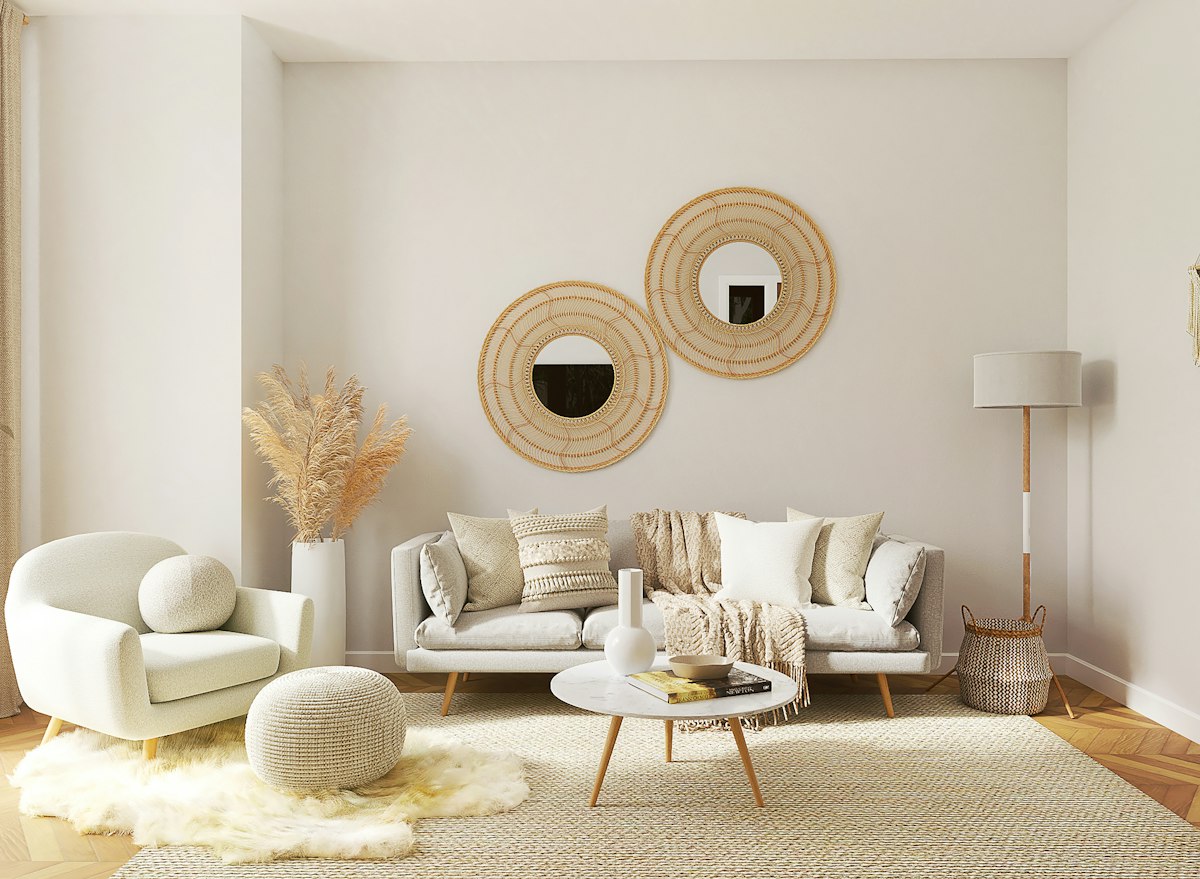 FSC-certified timber sourcing is no longer a “nice to have” for luxury buyers — it is a brand protection requirement enforced by hotel chains, premium retail partners, and increasingly by high-net-worth residential clients.
 The difference between a furniture supplier and a strategic manufacturing partner shows up in project outcomes like this — where every piece, across every room, meets the specification precisely and arrives on schedule.