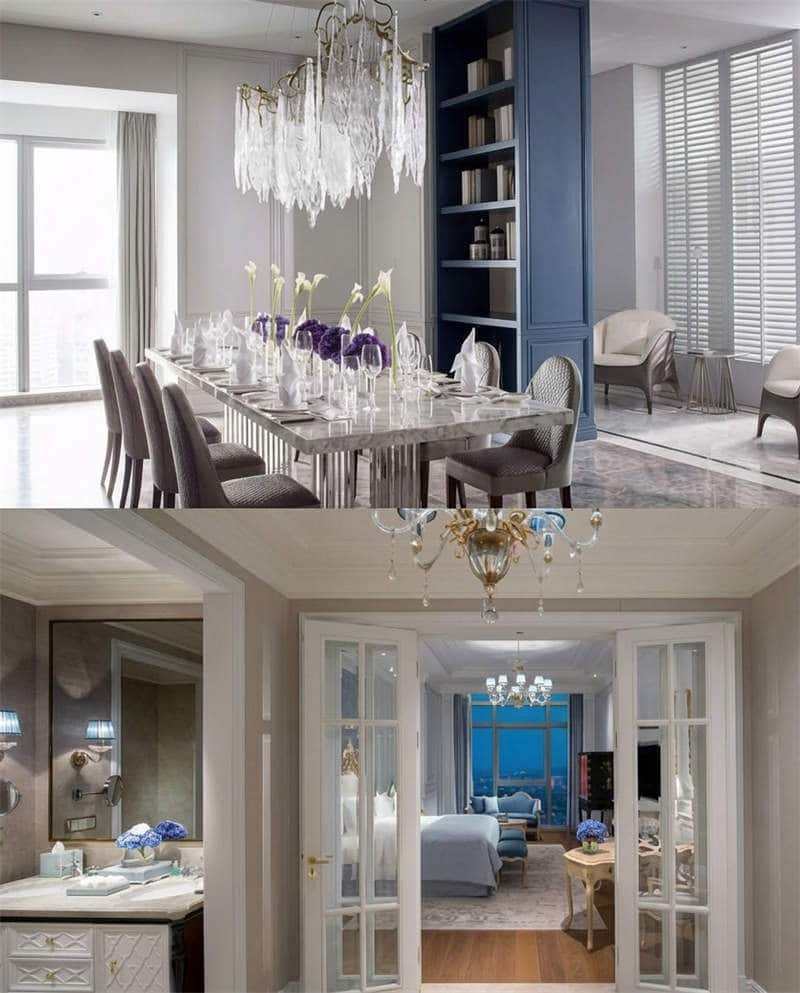
Inside the professional sourcing playbook—exclusive insights from leading interior designers...
Inside the professional sourcing playbook—exclusive insights from leading interior designers on accessing premium Italian furniture, building supplier relationships, and positioning luxury pieces as project anchors to elevate your client offerings and margins.
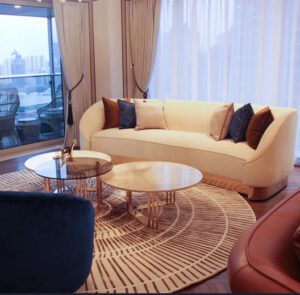
A completed luxury residential project where the Italian sectional sofa—custom-specified in Sage Bouclé with solid brass legs—became the anchor piece that determined every other material decision in the room.
Here’s a conversation that happens in design studios around the world, more often than anyone admits out loud.
A client presents a Pinterest board. The designer recognizes three of the pieces: one is a Minotti sectional at €18,000, one is a Poltrona Frau armchair at €6,500, and one is a custom B&B Italia daybed with an 18-week lead time. The client says: “Something like this—but can we do it within budget?”
The designers who handle this conversation best aren’t the ones who say “that’s out of range.” They’re the ones who know exactly which Italian manufacturers produce at what tier, how to access wholesale pricing through direct relationships, and how to substitute a comparable piece from an emerging brand in the same manufacturing district at 40% of the cost. That knowledge—built through years of supplier relationships, trade show attendance, and hard-won sourcing experience—is the real differentiator in a premium design practice.
This guide makes that knowledge explicit. If you are a furniture distributor, showroom operator, or design professional working in the luxury segment, what follows is a structured breakdown of how the most effective professionals are sourcing Italian furniture—and how to build the same operational infrastructure in your own practice.
The Italian Furniture Supply Chain: Understanding How Professional Designers Access Premium Pieces
Why Italian Furniture Commands Premium Positioning in Luxury Projects
Italy closed 2025 with furniture exports generating a trade surplus of €8.4 billion, despite a slight decline in overall export volume. The Italian furniture and interior design market is valued at USD 27 billion in 2025, growing toward USD 35 billion by 2031. These aren’t abstract market statistics—they represent the commercial weight of a manufacturing ecosystem that your end clients recognize, respect, and actively seek out.
When a hospitality designer specifies an Italian chair for a hotel lobby, they’re not buying a chair. They’re buying a material story—Brianza leather, hardwood from certified Venetian sources, upholstery techniques refined over four generations—that they can communicate to the property owner as a value narrative. That narrative is worth money. It’s why Italian pieces command a 30–60% premium over comparable-quality Asian-manufactured alternatives, and why clients with budgets for premium projects still reach for Italian specification even when cheaper options exist.
For your business, this premium has two commercial applications. First, it provides margin insulation. When you’re selling on the Italian story—craftsmanship, material provenance, design heritage—you’re not competing on price per unit. You’re competing on access, knowledge, and curation. Second, it creates repeat business. Clients who invest in Italian furniture at the right entry point (often one statement piece in a residential project, or the lounge seating in a boutique hotel lobby) become long-term customers for the same quality in subsequent projects.
The gap between retail and B2B wholesale access to Italian furniture is where your professional advantage lives. Retail buyers pay MSRP—typically 3x to 6x the manufacturer’s production cost. Designers and distributors with established trade accounts access pricing at 40–60% below MSRP. The buyers who have invested in direct manufacturer relationships access a further 10–25% below standard trade pricing. Understanding which tier of access your business currently occupies—and what it takes to move up—is the first strategic question to answer.
The Hidden Tiers of Italian Furniture Sourcing
Italian furniture distribution operates on multiple access tiers that most buyers outside the industry don’t fully understand. Think of it as a pyramid:
At the top are direct manufacturer accounts—typically reserved for distributors or large design firms placing $200,000+ in annual orders with a single manufacturer. These relationships offer the best pricing, first access to new collections, customization flexibility, and direct communication with the manufacturer’s design and production teams.
Below that are authorized distributor accounts—the standard access tier for professional buyers. Pricing at this level is 30–50% below retail, with access to trade samples, specification support, and order coordination. This is where most professional design firms and showrooms operate.
Further down are trade accounts at multi-brand showrooms (Design Centers, Trade Marts)—which offer convenient single-source access to multiple Italian lines but at pricing that reflects the intermediary’s own margin. Convenient, but the most expensive professional tier.
At the base is retail—where end consumers and non-trade buyers access pricing at full MSRP or near-MSRP. No design professional should be sourcing Italian furniture at this level for client projects.
Where you sit in this pyramid determines your cost base, your margin potential, and your ability to offer clients genuine exclusivity. The rest of this guide is about moving up.
Building Direct Relationships with Italian Manufacturers: The Insider Strategy
How Top Designers Establish First Contact with Italian Brands
The Salone del Mobile (Milan Furniture Fair) remains the single most valuable sourcing event in the Italian furniture calendar. Held annually in Milan, this is where 2,000+ exhibitors—from heritage brands to emerging mid-market manufacturers—present their collections to 300,000+ visitors from 160 countries. The 2026 edition ran April 21–26, and every serious B2B furniture professional with Italian sourcing aspirations should have it on their calendar as a non-negotiable annual investment.
But the designers who extract the most value from Salone don’t wander the fairgrounds reacting to what catches their eye. They arrive with a pre-built appointment schedule, a specific shortlist of brands they’re evaluating for new partnerships, and a clear set of criteria they’re applying to each manufacturer they meet.
Pre-event preparation for an effective Salone visit looks like this. In the six weeks before the show, research your target brands thoroughly—production region, material capabilities, export track record, authorized distributor networks in your territory. Make appointment requests directly through the brands’ trade portals or via their appointed agents. Prepare a professional credentials package that communicates your annual purchase volume, your client profile, and your business model. European manufacturers who see a professional operation—not just an individual designer looking for one piece—respond to trade inquiries differently.
Beyond Salone, Fuorisalone—the satellite events that spread across Milan’s design districts during the same week—provides access to emerging brands and smaller manufacturers who aren’t exhibiting at the main fair. Some of the most interesting new Italian furniture relationships start at an aperitivo in a Navigli courtyard with a brand whose factory has 30 employees and a 40-year design heritage.
Industry associations also matter. FederlegnoArredo, Italy’s national furniture manufacturing association, maintains a verified member directory that provides an independent filter for manufacturer credibility. Membership in FederlegnoArredo is not a guarantee of quality, but it confirms that the manufacturer meets the association’s documentation and compliance requirements.
Negotiating Terms That Work for Your Business Model
MOQ (Minimum Order Quantity)—the minimum number of units a manufacturer will produce or sell in a single order—is the friction point where most first-time sourcing relationships stall. Italian manufacturers’ MOQs typically range from as low as 1 unit (for heritage brands with dedicated bespoke capabilities) to 50+ units for certain fabric or finish selections. The range is driven by the manufacturer’s production model, their interest in your market, and their assessment of your potential as a long-term account.
The negotiation approach that works best for new relationships is volume commitment rather than volume proof. You may not have the order volume today to justify a manufacturer’s minimum requirements, but if you can present a credible projection—backed by your current client pipeline, your planned market development, and your business growth trajectory—many Italian manufacturers will extend favorable initial terms. They’re not looking for the largest order; they’re looking for the most reliable partner.
Payment terms for new relationships typically start at 50% deposit / 50% before shipment (pro-forma terms). As you build a track record—consistent orders, on-time payments, professional communication—most manufacturers will negotiate toward Net-30 or Net-60 terms. This matters for your cash flow: a Net-60 agreement on a $150,000 project order versus 50% deposit upfront represents a meaningful difference in working capital requirement.
Exclusive territory agreements deserve careful attention. Some Italian manufacturers offer regional or national exclusivity to distributors who meet volume commitments. These agreements protect your market position—no competing distributor in your territory can offer the same brand—but they also bind your purchasing commitments to that brand. Before signing an exclusivity agreement, validate that you can realistically meet the minimum purchase volume required to maintain exclusivity. Losing exclusivity because you didn’t hit the threshold is worse than not having it in the first place.
Maintaining Long-Term Supplier Relationships
The design professionals who get the best terms, the fastest production priority, and first access to limited new collections are almost never those who have spent the most money. They’re the ones who have been the most professional to work with.
Practical account management that Italian manufacturers notice and respond to: consistent and timely communication (responding to inquiries within 24 hours, even if only to confirm receipt), proactive updates on your market and pipeline, attendance at key brand presentations when manufacturers bring them to your territory, and prompt payment on every invoice without exception. These behaviors are rare enough in the B2B furniture world that they genuinely distinguish you as a preferred partner.
Quarterly reviews—even informal video calls with your manufacturer contact—create the cadence for understanding what’s coming in new collections, what production slots are available for priority scheduling, and what’s happening in the manufacturer’s supply chain that might affect your projects. A distributor who has a 30-minute call with their key Italian brand contact every quarter knows about lead time changes, new fabric releases, and pricing adjustments before they hit the general trade announcement. That’s meaningful operational intelligence.
Vetting Italian Furniture Brands: Quality Assurance for Your Clients
Red Flags When Evaluating Potential Suppliers
The “Made in Italy” label is valuable enough that it gets misused. Industry estimates suggest that a meaningful portion of furniture marketed as Italian is either assembled in Italy from non-Italian components, partially manufactured in Italy with finishing done elsewhere, or simply not Italian at all. Your professional reputation depends on knowing the difference.
The UNI 11674 national standard provides a defined framework for Italian furniture origin—production process and product requirements that qualify a piece for legitimate “Made in Italy” designation. CATAS (Centro di Assistenza Tecnologica e Assistenza alle Imprese)—Italy’s premier furniture testing and certification body—conducts third-party verification and awards certification to manufacturers who meet these requirements. Asking a prospective supplier for their CATAS certification documentation is a legitimate first-step vetting question.
Specific red flags that should trigger deeper investigation: inability or reluctance to provide factory location and visit access, pricing that is dramatically below comparable brands without a clear explanation, no presence at major Italian trade shows, no documented export history to professional markets, and business registration outside of recognized Italian furniture manufacturing districts. Legitimate manufacturers in Brianza, Veneto, or Tuscany are proud of where they make things. Those who are vague about their production origin have a reason to be.
Quality Control and Consistency Standards
For a sample order—your first test of a manufacturer’s actual production quality—here’s what to inspect systematically. Frame construction: test joint strength under load (a well-constructed sofa frame tolerates 2-3x the seated weight without flex or sound). Upholstery: check seam alignment, fabric tension consistency across the piece, and the accuracy of pattern repeat matching on printed or woven fabrics. Cushion fill: verify that high-resilience (HR) foam density matches the specification (typically 30-45 kg/m³ for quality commercial seating). Finish consistency: hold pieces under uniform light to check for color variation, finish depth inconsistency, or surface defect coverage.
Documentation that accompanies the sample should include material specifications (fabric and leather grade with supplier reference), construction method notes, foam density certification, and any applicable test results for fire or durability performance. A manufacturer who cannot provide this documentation for a sample order will not provide it for a production order—and you will not have it when your client or their regulatory authority asks for it.
Warranty terms vary significantly among Italian manufacturers. Most premium brands offer 2-year structural warranty coverage; some extend to 5 years for frame components. Understand the claims process before you need it: who to contact, documentation required, typical resolution timeline, and whether replacement means new production (10–14 weeks) or component repair. Build these terms into your client contracts so the warranty expectation is set correctly from the start.
Sustainability and Ethical Sourcing Considerations
Your luxury residential and hospitality clients are increasingly operating under procurement policies that require sustainability documentation. Corporate clients with ESG (Environmental, Social, Governance) frameworks—the financial reporting structure that governs environmental and social practices at large organizations—need supplier certifications to meet their own reporting requirements.
The certifications that carry weight in the Italian furniture supply chain include FSC (Forest Stewardship Council) certification for wood products, confirming responsible forest sourcing; ISO 14001 for environmental management systems; GREENGUARD Gold for indoor air quality compliance; and ISO 9001 for quality management systems. Italian manufacturers who hold these certifications—and can provide current documentation—are ready for the procurement conversations that corporate and high-end hospitality clients require.
The commercial angle: a distributor or design professional who can provide complete sustainability documentation alongside their furniture specification isn’t just meeting a compliance requirement. They’re removing an obstacle that their competitor might not be able to clear. In competitive bids for corporate office fit-outs, hospitality projects under sustainability certification programs, or luxury residential developments with green building credentials, this documentation capability is a genuine differentiator.
Strategic Sourcing for Different Project Types: Tailoring Italian Furniture to Your Clientele
The residential luxury client is buying a statement and a story. They are not buying furniture—they’re buying the ability to describe to their guests that the sofa is Poltrona Frau leather in Parchment, hand-stitched in Tolentino. They’re buying the knowledge that the dining table is solid Canaletto walnut from a third-generation atelier in Veneto that supplies to European palaces.
Your sourcing strategy for residential luxury projects is built around identifying the two or three anchor pieces that will define the space—typically the primary seating in the living area, the dining table, and one statement piece in the master bedroom. These anchor pieces should be Italian and should be sourced from manufacturers whose heritage and material standards you can communicate authentically. The remaining specification can be supplemented from complementary sources without sacrificing the project’s Italian luxury positioning.
Customization is where residential luxury projects gain their real design identity. A sofa in a brand’s standard configuration, in a standard fabric, is still Italian—but it’s not unique. A sofa with custom dimensions that fills an architectural alcove exactly, in a hand-dyed leather that was selected during a factory visit, is the piece that ends up in the project photography and drives referral business. Push your Italian manufacturer partnerships toward genuine customization capability for residential luxury work, even if it means accepting longer lead times and higher minimum thresholds.
Hotel and Hospitality Fit-Out: Sourcing at Scale
Hospitality sourcing operates under pressures that residential sourcing does not face: standardized specifications across 80, 150, or 300 rooms; compliance documentation for fire codes and durability certification; phased delivery schedules tied to construction milestones; and absolute deadline pressure (a hotel that misses its opening date loses revenue that cannot be recovered).
The Italian manufacturer partners who are worth working with for hospitality at scale are those who can provide three things that smaller artisan workshops often cannot: documented contract-grade certification (EN 1021-1/2 fire testing, CATAS durability certification to the appropriate cycle count for the application), phased delivery capability (releasing production in coordinated tranches tied to your construction schedule), and replacement parts availability (documented program for sourcing matching components in years 3–7 of the furniture’s service life, when wear repairs become necessary).
For multi-property hotel groups—where you’re specifying across three, five, or ten properties with a common brand standard—Italian manufacturers who can produce consistent specification across long production periods are the critical partners. Introducing one Italian partner into a hotel group’s FF&E (Furniture, Fixtures & Equipment—the industry term for all movable furnishings in a hospitality project) specification creates a template that can be applied across the portfolio, with compounding volume benefits over the relationship timeline.
JL&C Furniture works with hospitality procurement teams on exactly this model—establishing a specification template that can be produced consistently across multiple properties, with phased delivery and documentation support for compliance requirements.
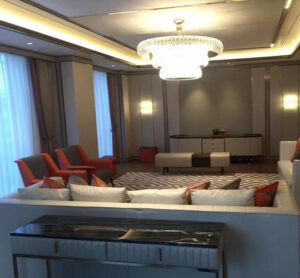
A hospitality lobby specification anchored by a custom-curved Italian seating system. The velvet is contract-grade (80,000+ Martindale rating); the dimensions were specified to fill the circular floor plan exactly. Standard catalog configurations couldn’t solve this brief.
Commercial and Corporate Spaces—Professional Elegance
Corporate specification requires durability documentation that residential sourcing rarely demands. BIFMA—the Business and Institutional Furniture Manufacturers’ Association, which sets commercial furniture performance and safety standards in North America—certification is a baseline requirement for any upholstered commercial seating. European markets require CE marking and EN standard compliance for public-space furniture.
Italian manufacturers with dedicated commercial contract lines—distinct from their residential collections—produce furniture that meets these compliance standards while maintaining the aesthetic quality that corporate clients in premium offices want. The commercial line often uses the same frame and design language as the residential version, but with upgraded foam density, reinforced joint construction, and flame-retardant fabric treatments. Specifying from the correct product line (commercial vs. residential) is a fundamental professional competence—getting it wrong creates liability that your client’s facility manager will trace back to you.
Corporate clients with sustainability requirements—and this now includes most large organizations with published ESG commitments—need your Italian manufacturers to provide material composition documentation, VOC (Volatile Organic Compound) emission testing results, and ideally GREENGUARD or equivalent certification. This is not a sourcing obstacle; it’s a qualification filter that removes competitors who haven’t built the supply relationships to provide it.
Navigating Pricing, Margins, and Profitability
Understanding the Italian Furniture Pricing Model
The markup structure in Italian furniture distribution is one of the most misunderstood aspects of the B2B supply chain. At the manufacturing level, a mid-range Italian lounge chair might have an all-in production cost of €400–€600. By the time it reaches a design client through a standard retail or multi-tier distribution channel, it is priced at €2,500–€4,500+.
Each layer in that price multiplication adds real value—but also creates an opportunity for professional buyers who understand the structure. The key reference points:
Pricing Tier
Approximate Level vs. Manufacturer Cost
Who Accesses This
Retail / Consumer MSRP
4x–7x manufacturer cost
End consumers, retail buyers
Trade showroom pricing
2.5x–4x manufacturer cost
Interior designers (standard trade account)
Authorized distributor pricing
1.8x–2.5x manufacturer cost
Established distributors and showrooms
Volume distributor / direct
1.4x–1.8x manufacturer cost
High-volume direct accounts
Understanding where your current relationships sit in this table—and what volume commitments unlock the next tier—is the foundation of your margin planning. A distributor who moves from standard trade pricing to direct account pricing on a €500,000 annual sourcing program can capture €50,000–€100,000+ in additional margin annually on the same product mix.
The additional cost layers that erode your landed cost calculation are: international shipping (ocean freight for European shipments typically runs €1,500–€4,000 per container, with LCL rates of €80–€130 per cubic meter), import duties (which vary by country and product classification—always use the official Harmonized Tariff Schedule for your market), insurance (typically 0.5–1.5% of goods value for premium furniture), and domestic delivery and handling. For accurate project budgeting, always calculate landed cost (manufacturer price + all logistics costs to your location), not manufacturer price alone.
Building Healthy Margins While Staying Competitive
Interior designers who source Italian furniture professionally and mark it up for clients typically apply a 20–35% markup above their trade cost when billing residential clients for furniture procurement. Distributors and showrooms operating in the B2B channel apply a 30–50% margin above their landed cost when selling to design professionals or end buyers.
The margin structure that protects you without pricing you out of competitive bids is built on a simple principle: your competitors who are competing on the same Italian brands at the same price point are your real pricing ceiling. Your competitors who cannot access the Italian brands at all—or who access them through more expensive intermediary channels—are your real competitive advantage.
Value-add services that justify your margin above product cost: 3D visualization and space planning (which saves clients from specification errors they’d otherwise discover on delivery), customization management (coordinating with manufacturers on custom specifications, which requires expertise and relationship access that the client cannot replicate independently), project coordination (managing production schedules, shipping coordination, installation logistics), and post-delivery support (warranty claims coordination, replacement parts sourcing). Each of these services has a cost to you—your team’s time—and a value to the client that justifies your total margin on the project.
Managing Cash Flow and Inventory
The cash flow dynamics of Italian furniture sourcing are front-loaded. You typically pay 30–50% deposit to the manufacturer on order confirmation. Your client typically pays you 30–50% deposit on signing the purchasing agreement. If your client deposit exceeds or matches your manufacturer deposit—which it should, with careful terms structuring—you are not financing the production yourself.
The inventory management principle for professional Italian furniture sourcing is: hold samples, not stock. Physical samples (current display pieces representing each brand’s construction quality and key finishes) are the minimum viable investment for credible professional sourcing. Finished inventory—holding configured pieces before you have a confirmed client order—ties up capital in goods that may not fit the next client’s brief and requires warehouse space that generates overhead without generating revenue.
For fast-moving residential clients with standard preferences, a small quick-ship inventory in proven configurations can reduce lead time and close more sales. For project-driven clients (hospitality, corporate, high-end residential), made-to-order is almost always the better model: the client is already accepting a delivery timeline, and made-to-order ensures the specification matches their project requirements exactly.
The Role of Trade Shows and Industry Events in Sourcing Strategy
Maximizing Your Time at Salone del Mobile and Other Key Events
The professional return on a well-planned Salone del Mobile trip is disproportionate to the investment. Three to five days in Milan, with pre-booked appointments with eight to twelve target manufacturers, can establish the supplier relationships that define your business for the next five years. The key is pre-planning.
Your pre-event research checklist should include: identifying which brands are exhibiting in the hall spaces you’re targeting (Salone organizes exhibitors by product category—knowing which hall has the brands you want saves time on the floor), downloading manufacturer catalogs and pricing structures in advance so your conversations can move past introductions to commercial terms, and preparing a professional sourcing brief that describes your business, your typical project volumes, your client profile, and what you’re looking for in a new brand partnership.
On the show floor, your assessment of a potential manufacturer goes beyond aesthetics. Ask about: production capacity and current lead times, the minimum order for their standard configurations versus their custom capability, their export track record in your market, and their current distributor structure (which tells you whether exclusive territory access is available). Look at the construction quality of their pieces under the harsh trade show lighting, which reveals finish inconsistencies that studio photography conceals.
Beyond the fair itself, Fuorisalone events at locations like the Tortona Design District and the Brera Design District often feature the most innovative presentations from brands who are making design statements outside the structured fair environment. Some of the most commercially interesting sourcing relationships in premium design practices started with a Fuorisalone installation.
Leveraging Virtual and Hybrid Sourcing Opportunities
The post-2020 investment in digital brand infrastructure by Italian manufacturers has made remote sourcing more viable than it was previously—but not as effective as in-person contact for building new relationships. Use virtual tools strategically: digital catalogs and specification sheets for your reference library (most brands now provide downloadable technical documentation via their trade portals), video consultations with brand representatives for follow-up after initial in-person contact, and virtual showroom tools for sharing options with clients who can’t physically visit your showroom.
For evaluating an existing supplier partner’s new collection, virtual is efficient. For establishing a new manufacturer relationship with someone you’ve never met, prioritize in-person whenever the opportunity exists. The nuances of how a manufacturer’s team communicates, how they handle your questions about production limitations, and how they respond to commercially oriented discussions about exclusivity and terms—these read differently in person than on a video call.
Post-Event Follow-Up That Converts Contacts Into Partnerships
The best-prepared attendees at Salone del Mobile leave the fair with 40 business cards and six follow-up commitments. The most commercially effective attendees leave with three prioritized manufacturer targets and a clear follow-up timeline for each.
Within 72 hours of returning from Milan, send a brief but professional follow-up email to each priority contact: reference your specific conversation at the show, confirm your interest in exploring a partnership, and propose a specific next step (a video call in the following two weeks, a sample request, or a visit to their factory during the following season). Manufacturers who exhibit at Salone receive hundreds of business cards; the buyers who receive priority attention are those who follow up promptly and specifically.
Your CRM system—or at minimum a structured spreadsheet—should capture for each new contact: the brand name, your primary contact (name, role, email), what was discussed, what was agreed, the agreed next step and timeline, and the outcome of each follow-up. Relationship building in Italian furniture sourcing is a multi-year process. The systematic documentation of each contact’s history is what transforms warm trade show conversations into functioning supplier partnerships twelve months later.
Exclusive Designer Insights: Real Sourcing Stories from Working Professionals
Interview 1—The High-End Residential Specialist: Sourcing Signature Pieces for Ultra-Luxury Homes
Composite from interviews with residential design professionals in Singapore and Dubai operating in the AED 2M–15M residential project range.
She identifies emerging Italian brands before they become mainstream by following a simple heuristic: if a brand is at a significant Fuorisalone installation rather than the main fair hall, and their production quality matches their design ambition, they are six to eighteen months from being on every designer’s reference list—and still accessible at early adopter pricing.
Her approach to customization is rooted in restraint. She doesn’t customize for the sake of differentiation; she customizes to solve a real problem. The custom 3.6m sofa she specified for a Dubai penthouse last year wasn’t a creative exercise—it was the only solution to a 4.2m wall that no standard configuration could fill without leaving an awkward visual gap. The customization was functional, and she presented it to the client as the technically correct solution, not a luxury upgrade.
On timelines: she builds 16 weeks into every Italian furniture specification, regardless of what the manufacturer’s sales team quotes. “The official lead time is a best-case scenario. My client’s project schedule is built around the realistic scenario.”
Interview 2—The Hospitality Fit-Out Expert: Managing Large-Scale Italian Furniture Projects
Composite from interviews with hospitality FF&E designers managing 50–300 room hotel projects across Southeast Asia and the Middle East.
For multi-property hotel groups, she develops a specification template with one or two Italian anchor pieces per room type—typically the lounge chair or the bed base—and sources the balance of the specification from complementary manufacturers offering contract-grade quality at hospitality volume pricing.
Her most valuable negotiating tool with Italian manufacturers for large projects is not the order size—it’s the consistency guarantee. “I tell them: this property is the first of four in this group’s pipeline. If you can deliver on this project, you have the next three as well. That’s more compelling than any single order value.”
When timelines get tight—which on construction-driven hotel opening schedules they almost always do—she maintains a shortlist of Italian manufacturers who have demonstrated genuine expedite capability. Not every brand can do 8-week production on a hospitality specification; the ones who can are worth paying a premium for when the construction schedule compresses.
Interview 3—The Showroom Manager: Curating Collections That Sell
Composite from interviews with luxury furniture showroom managers in London and Hong Kong.
Her selection framework for Italian brands to stock is built on three filters: the brand must have genuine manufacturing heritage (not a design studio outsourcing to non-Italian factories), must offer the material depth her clients require (minimum 150 fabric options, full leather grade range), and must be able to support her team with technical specification resources when complex client orders arise.
She rotates display pieces on a 24-month cycle, which requires discipline. “An 18-month-old display piece is not showing our clients what they’ll receive today—it’s showing them a collection that may already have updated specifications, new finishes, or discontinued options.” The carrying cost of current displays is a real investment, but the alternative—specifying from an outdated display and delivering a piece that doesn’t match what the client chose—is commercially catastrophic.
Staff training is her most underestimated competitive investment. Her team can articulate the difference between full-grain and semi-aniline leather not because they read a brochure but because they visited two tanneries in Tuscany with her three years ago. That firsthand knowledge converts client questions into closed sales.
Interview 4—The Furniture Distributor: Building a Profitable B2B Model
Composite from interviews with Italian furniture distributors operating in the US, Australia, and Southeast Asia.
He established his first exclusive Italian brand relationship not by being the largest buyer in his market, but by being the most prepared. His initial meeting with the brand’s export manager included a competitor analysis of the brand’s current distribution in his territory (which revealed gaps), a market sizing estimate for the brand’s price tier, and a 24-month sales projection with the methodology explained.
“I came to that meeting as a business partner who happened to want to distribute their furniture. Most distributors come as buyers who want good pricing. Those are completely different conversations.”
Territory management for exclusive distribution agreements requires consistent inventory management, active market development (not just order-taking), and regular reporting back to the manufacturer on market conditions and competitor activity. The manufacturers who grant exclusivity are granting it in exchange for active market development—those who treat exclusivity as a passive price advantage lose it.
At JL&C Furniture, the approach to distributor and showroom partnerships follows this same principle. Our most effective partners aren’t those with the largest first orders—they’re those who invest in understanding the product, training their teams, and developing their local market with genuine commitment.
Digital Tools and Resources for Professional Sourcing
Industry Platforms and Directories for Finding Italian Suppliers
The FederlegnoArredo member directory—Italy’s national furniture industry association—provides a verified starting point for manufacturer research. Membership is a baseline credibility filter. Archiproducts offers a comprehensive Italian design brand directory with technical specification access and direct manufacturer contact. Made in Italy.com aggregates verified Italian manufacturers with export capability.
For North American buyers, the NeoCon contract furniture trade fair in Chicago—the largest North American commercial furniture event—is where Italian brands with established US distribution present alongside their American counterparts. It’s a useful supplement to Salone for understanding how Italian brands position their collections for the North American contract market.
Assarredo—the Italian furniture manufacturers’ association within FederlegnoArredo—publishes annual export market data that helps you understand which categories of Italian furniture are growing in your region. This market intelligence supports your own sourcing prioritization.
Project Management and Documentation Systems
For managing multiple Italian supplier relationships and concurrent projects, a structured CRM or project management system is not a luxury—it’s the operational requirement that separates a scalable business from a fragile one-person operation.
Monday.com y Programa (purpose-built for interior design project management) are widely used in the design professional community. For B2B furniture distributors managing multiple concurrent sourcing relationships and delivery timelines, Monday.com’s flexibility allows you to build custom workflows tracking supplier contact history, open order status, production milestones, and delivery commitments in a single view.
The documentation standard for professional Italian sourcing should include, for every active supplier relationship: current trade pricing, MOQ terms, standard and rush lead times by product category, key contact details, current certifications with expiry dates, and a log of every significant communication. This documentation is not bureaucracy—it’s the operational memory of relationships that may span 10+ years and involve dozens of individuals on both sides.
Communication Tools for International Relationships
Italian business culture values personal relationship and communication quality. A distributor who sends clear, professionally formatted emails with complete order specifications—quantities, product codes, fabric grades, finish references, delivery address, and project timeline—makes their Italian contact’s job easier and builds a reputation as a professional buyer worth prioritizing.
Time zone management for Italian partnerships: Italy operates on CET (Central European Time), which is typically 6–9 hours ahead of US business hours and 7–8 hours behind East Asia. A 9 AM Milan response time is 3 AM New York—plan your communication rhythm accordingly. Scheduling a standing video call at a time that works for both parties (typically early morning Italian time, which aligns with end-of-day US time) creates the cadence for relationship maintenance.
Translation considerations: most Italian furniture brands with active export programs employ English-speaking export managers or work with agents who are fluent in English. However, sending communications in Italian—even imperfect Italian—is noticed positively and communicates respect for the business relationship. Basic Italian for business correspondence is a modest investment that pays relational dividends in supplier partnerships.
Common Sourcing Challenges and Professional Solutions
Challenge 1—Long Lead Times and Project Timeline Pressure
The fundamental tension in Italian furniture sourcing is that the craftsmanship that makes Italian pieces valuable takes time to produce—and your clients often want delivery on a timeline that doesn’t account for the production reality.
Standard lead times for Italian furniture: 8–14 weeks for fully specified custom orders from most premium brands, 6–8 weeks for expedited production on standard configurations (often with an upcharge of 10–20%), and 4–6 weeks for quick-ship items from stock-held configurations. Add 3–5 weeks for transatlantic shipping and customs clearance when the manufacturer is in Italy and your delivery point is North America or Asia.
The professional solution is timeline management, not timeline minimization. Establish the lead time reality upfront in every client conversation—present it as a production schedule, not an inconvenience. A client who knows in January that their April project opening requires an immediate order confirmation has a different relationship with the lead time than one who discovers it in February. The calendar conversation, done early, is almost always resolvable. The same conversation done late becomes a crisis.
For recurring clients with consistent specification patterns, pre-ordering—placing production orders in advance of confirmed client briefs, based on your historical demand data—allows you to offer faster delivery without absorbing the full inventory carrying risk. Pre-order your most consistently specified configurations; make-to-order everything else.
Challenge 2—Minimum Order Quantities That Don’t Match Your Business Model
MOQ requirements that work for a large hospitality distributor (50 units of a dining chair) are structurally incompatible with a residential design practice specifying 2 units for a dining room. This mismatch is real—but there are several practical navigation strategies.
Cooperative ordering: Building a relationship with one or two other non-competing design professionals in your market who are willing to pool orders to reach MOQ thresholds. A three-way cooperative order of 12 units (4 per designer) reaches a manufacturer’s 10-unit minimum for a specific fabric selection, while maintaining each designer’s individual specification identity.
Negotiating initial order flexibility: Many Italian manufacturers will accept below-minimum orders for a first relationship at standard or slightly elevated pricing, in exchange for a commitment to a longer-term volume relationship. Frame your first order as a market development investment, not a one-off purchase, and many manufacturers will find a way to accommodate you.
Carrying the cost strategically: For pieces that you expect to specify repeatedly across multiple clients, ordering 3–5 units at the MOQ price point—holding two or three as quick-ship inventory—can be cost-effective if the per-unit savings and the client service advantage of immediate availability justify the holding cost.
Challenge 3—Authenticity and Gray Market Products
The gray market in Italian furniture—products sold outside the manufacturer’s authorized distribution network, sometimes at significantly discounted prices—creates real risk for professional buyers. Gray market product may have been originally intended for a different market (and therefore not compliant with your local regulations), may be discontinued inventory without replacement parts or warranty support, or may be genuinely counterfeit.
The protection is straightforward: source exclusively from authorized channels. Request written confirmation from any new supplier of their authorized distributor status with each Italian brand they represent. Legitimate manufacturers maintain published lists of their authorized distributors by market—contact the manufacturer directly to verify any new supplier’s authorization status before placing a material order. The short-term pricing discount available through gray market sourcing is structurally incompatible with the long-term reputation risk of delivering non-compliant or unsupported product to clients.
Challenge 4—Currency Fluctuations and Price Volatility
Italian furniture is euro-denominated. For buyers operating in USD, GBP, AUD, or other currencies, the EUR/local currency exchange rate is a real cost variable that can move 5–15% over the production cycle of a large order. A project quoted in February that delivers in August may have absorbed a meaningful currency movement between quote and payment.
The professional approach involves three elements. First, build a currency buffer of 5–8% into your project budgets on euro-denominated sourcing—smaller than a full hedging program, but adequate to absorb normal exchange rate movement. Second, for orders above $100,000, investigate forward contracts—agreements with your bank or a currency specialist to lock in a specific exchange rate for a future payment. StoneX and similar currency management specialists offer forward contract facilities accessible to business buyers. Third, communicate transparently with clients about currency variables in project pricing—build an explicit currency clause into your project proposals that defines the exchange rate basis and the mechanism for adjusting if rates move significantly.
Challenge 5—Customization Requests That Exceed Manufacturer Capabilities
Not every Italian manufacturer can deliver every customization that clients request. A client who wants a sofa in a fabric they sourced from a Paris textile house, at dimensions 20% larger than any standard configuration, with a non-standard leg material, is asking questions that may individually be answerable but collectively exceed what any single manufacturer can accommodate.
The professional resolution starts at the supplier vetting stage: understanding each manufacturer’s customization scope—what’s routinely possible, what’s possible at premium lead time and cost, and what’s genuinely outside their production capability—before a client brief arrives. This knowledge, maintained in your supplier documentation, allows you to match client briefs to manufacturer capabilities accurately and quickly.
When a client request genuinely exceeds your current supplier network’s capability, the professional response is not “we can’t do that.” It’s “here’s a comparable approach that achieves the same design outcome within what’s producible.” That reframing, backed by genuine specification alternatives that address the same functional and aesthetic goals, is the difference between a design professional and an order taker.
Building Your Competitive Edge: Positioning Italian Furniture in Your Market
Educating Your Market—Why Italian Furniture Matters
The clients who invest in Italian furniture are not buying materials. They’re buying a story—and the professionals who tell that story most effectively are the ones whose sourcing relationships run deepest.
Practical market education that works: client-facing one-page brand profiles that describe a manufacturer’s founding year, regional manufacturing heritage, key designers they’ve collaborated with, and material sourcing practices. These don’t need to be polished publications—a professionally formatted A4 document that your designer or showroom team can present during a client meeting communicates the same narrative content as a glossy brand catalog, with the advantage of being written in your voice rather than the manufacturer’s marketing department.
The lifecycle cost argument is consistently underutilized in Italian furniture selling. A contract-grade Italian lounge chair at €3,500 that lasts 12 years in a commercial environment represents €291 per year. A comparable piece at €1,200 that requires replacement at year four represents €300 per year—and incurs the procurement and installation cost of replacement. Clients who think in total cost of ownership terms respond to this argument. Build it into your value communication.
Differentiation Strategies for Showrooms and Distributors
The showroom that stocks the same Italian brands as every other showroom in their market is not differentiated—they’re interchangeable, which drives price competition. The showroom that carries two or three Italian brands that competitors don’t stock—either emerging brands they discovered before they were mainstream, or heritage brands they’ve built an exclusive relationship with—is the showroom that design professionals seek out for projects where they need something different.
Identifying emerging Italian brands before they achieve mainstream distribution is a sourcing skill built from consistent trade show attendance, active engagement with Italian design media, and relationships with Italian brand development consultants who operate in this space. A brand that was presenting a strong first Salone collection in 2024, building their export distribution in 2025, is a candidate for an exclusive territory relationship that will be much harder to obtain in 2027.
JL&C Furniture’s product lines are designed to complement premium Italian brand sourcing programs—providing showroom operators and distributors with high-quality complementary pieces that expand project specification flexibility without competing with Italian heritage brands in their core positioning.
A curated showroom floor where three Italian brand displays and a dozen material sample stations do more selling than a 200-piece catalog. The curation is the value.
Building a Reputation as the Italian Furniture Expert
Reputation in the luxury design market is built slowly and lost quickly. The professional who is known as the go-to source for Italian furniture sourcing in their market has built that reputation through consistent delivery on promises, consistent quality across every project, and consistent willingness to share knowledge that helps their client community.
Practical thought leadership that builds this reputation doesn’t require publishing in design magazines (though that helps). It requires consistency in the channels your clients and referral sources already use: an Instagram presence that documents real project sourcing processes (the tannery visit, the factory sample approval, the delivery coordination for a hotel lobby opening), LinkedIn content that addresses the real questions your professional clients face (how to structure payment terms with Italian manufacturers, how to handle a custom order that arrives late), and consistent attendance at the events where your professional network builds.
The referral dynamic in luxury design is powerful and specific: a hotel designer who refers a colleague to you for Italian furniture sourcing is staking their professional reputation on your execution. Protect that reputation by delivering exactly what you committed to, communicating proactively when anything changes, and following up after delivery to confirm the client’s satisfaction. The call you make three weeks after a major delivery to ask “is everything as you expected?” costs five minutes and generates the kind of relationship capital that produces the next referral.
🎬 Watch: Inside Italian Furniture Manufacturing
Understanding the manufacturing process behind Italian furniture—from how tanneries prepare leather to how assembly lines coordinate custom upholstery—is one of the most effective tools for educating clients on why Italian craftsmanship commands a premium.
▶ Watch: “First Time at Milan Design Week? Watch This Before You Go” — a practical walkthrough of the Salone del Mobile experience from a design professional’s perspective. Share with your team before your next trade show trip.
Sourcing Timeline and Planning Reference
The table below gives you a realistic planning framework for Italian furniture sourcing across different project types and timelines. Use this as a client communication tool and as an internal project management reference.
Action
Timing Before Client Delivery
Notes
Define project specification and brief
7–8 months
Identify anchor pieces and budget allocation
Research and shortlist Italian manufacturers
6–7 months
Verify certifications, capabilities, export track record
Request samples and pricing from shortlisted brands
5–6 months
Allow 2–3 weeks for sample transit
Present options to client; gain specification approval
5 months
Use 3D visualization for custom configurations
Place confirmed order with manufacturer deposit
4.5–5 months
Standard production lead time: 10–14 weeks
Production milestone check with manufacturer
3 months
Confirm on-schedule production
Factory quality inspection (pre-shipment)
2 months
Arrange campione approval for large orders
International shipping transit
5–8 weeks
Ocean freight for European shipments
Customs clearance and domestic delivery
2–3 weeks
Buffer for customs processing
On-site delivery and client acceptance
Target date
Document delivery, confirm client sign-off
Conclusion: Your Roadmap to Professional Italian Furniture Sourcing
Sourcing Italian furniture professionally is not a transaction skill—it’s a relationship skill, a market intelligence skill, and an operational management skill, all operating simultaneously.
The designers and distributors who do it best have built something that takes time and deliberate effort to construct: a portfolio of genuine manufacturer relationships, grounded in mutual professional respect and consistent commercial commitment; a working knowledge of the supply chain deep enough to navigate its complexity without losing margin to it; and a client communication capability that translates the intricacies of Italian craftsmanship into language that makes clients confident they’re making the right investment.
The five things worth remembering from this guide: direct manufacturer relationships are accessible but require volume commitment and professional preparation to unlock. Understanding the supply chain tiers—and which tier you currently occupy—determines your cost base and your margin ceiling. Strategic sourcing for different project types requires different supplier profiles and different commercial terms. Quality verification is not optional; your professional reputation is built on the quality that your clients receive. And continuous investment in supplier relationships, industry participation, and market knowledge is the engine of competitive advantage that doesn’t have an off switch.
The Italian furniture market rewards professionals who take it seriously. It is not forgiving of those who treat it as a catalog exercise.
Ready to Elevate Your Sourcing Strategy?
Download our exclusive “Italian Furniture Sourcing Checklist for Professionals”—a practical tool designed specifically for interior designers, showroom managers, and furniture distributors. Includes a pre-supplier vetting questionnaire, documentation templates, lead time and MOQ negotiation framework, and a quality assurance inspection checklist.
Or connect with the JL&C Furniture sourcing specialists to discuss your specific business model and how to access premium Italian-influenced collections with competitive terms and design flexibility.
A luxury residential dining specification: solid marble dining table custom-cut to dimension, full-grain leather chairs with hand-stitched contrast piping. The entire specification sourced through a single Italian manufacturer relationship built over three years.
Glossary of Key Sourcing Terms
BIFMA — Business and Institutional Furniture Manufacturers’ Association. Sets performance and safety standards for commercial furniture in North America. BIFMA certification is a baseline requirement for contract-grade furniture in US commercial projects.
CATAS — Centro di Assistenza Tecnologica e Assistenza alle Imprese. Italy’s primary furniture testing and certification body. CATAS certification provides independent verification of construction quality, durability, and material standards.
Campione — Italian for “sample.” The pre-production approval sample that represents the final specification and against which all production units in a batch are inspected.
COM / COL — Customer’s Own Material / Customer’s Own Leather. Upholstery specified from a fabric or leather source outside the manufacturer’s standard library. COM/COL orders typically add 2–4 weeks to standard lead times.
ESG — Environmental, Social, and Governance. The framework governing sustainability and ethical practice reporting at corporate organizations. Increasingly relevant to furniture procurement as corporate clients require ESG-compliant supply chains.
FF&E — Furniture, Fixtures & Equipment. The industry term for all movable furnishings in a hospitality or commercial property. FF&E procurement is the specialty discipline for hotel and large commercial project sourcing.
FSC — Forest Stewardship Council. An international certification system for responsible forest management. FSC certification on wood furniture confirms that the timber source meets responsible forestry standards.
FederlegnoArredo — Italy’s national furniture and wood industry federation. Member directory serves as a baseline credibility filter for Italian manufacturer verification.
Fuorisalone — The network of satellite design events that take place across Milan’s design districts during the same week as Salone del Mobile. Often features more innovative and experimental brand presentations than the main fair.
GREENGUARD — A certification program verifying that furniture products meet chemical emission standards for indoor air quality. GREENGUARD Gold certification is required for furniture in schools and healthcare settings; increasingly expected in corporate procurement.
Landed Cost — The total cost of a product including manufacturer price, international shipping, insurance, import duties, and domestic delivery to your location. Always calculate landed cost, not manufacturer price, for accurate project budgeting.
MOQ — Minimum Order Quantity. The minimum number of units or material quantity a manufacturer will accept for a specific order or specification.
Martindale Rating — The measurement of fabric durability expressed in “rubs”—the number of abrasion cycles a fabric can withstand before showing wear. Residential minimum: 15,000 rubs. Light commercial: 30,000. Heavy commercial/hospitality: 80,000+.
UNI 11674 — The Italian national standard defining process and product requirements for “Made in Italy” furniture certification.
Q1: What’s the minimum order quantity I should expect when sourcing directly from Italian manufacturers?
MOQs vary significantly by brand tier and product category—typically ranging from 1 unit (heritage brands with bespoke capabilities) to 50 units for certain fabric selections at mid-market manufacturers. Emerging brands are often more flexible than established names. As a practical baseline: for fully custom configurations, most quality Italian manufacturers will accept single-unit orders at standard trade pricing. For specific fabric or finish selections, MOQs of 3–10 units are common. Your negotiating leverage increases with volume commitment and relationship duration—a distributor placing $300,000 annually has different terms than one placing their first $15,000 order.
Q2: How do I verify that an Italian furniture supplier is legitimate and not a gray market reseller?
Request manufacturing certification documentation (CATAS, ISO 9001, UNI 11674 where applicable), ask for factory visit access or third-party audit references, verify their presence at Salone del Mobile or other major Italian trade events, check business registration in Italy through the official Registro delle Imprese, and confirm their authorized distributor status directly with the manufacturer they claim to represent. Legitimate manufacturers and authorized distributors are transparent about their supply chain. Those who resist documentation requests are communicating something important.
Q3: What payment terms should I negotiate with Italian suppliers as a distributor or showroom?
Standard opening terms run 30–50% deposit on order confirmation, balance before or upon shipment. As you build a track record of consistent volume and on-time payment, negotiate toward Net-30 or Net-60 on the balance. Currency considerations matter: clarify which currency the invoice is denominated in and build a 5–8% currency buffer into your project budgeting for euro-denominated orders. For orders above $100,000, investigate forward contracts with a currency specialist to lock in exchange rates for the payment cycle.
Q4: How far in advance do I need to plan for Italian furniture orders?
For standard production: 10–14 weeks manufacturing plus 5–8 weeks transit and customs clearance = 15–22 weeks from order to delivery. For custom specifications: add 2–4 weeks per specification variable (custom dimensions, COM fabric, non-standard finish). For hospitality-grade compliance specifications: add 2–4 additional weeks for certifications and testing documentation. A 6-month planning horizon for standard orders and 7–9 months for complex or hospitality-grade specifications is the professional standard. Build your project specification and order schedule around realistic timelines from the first client conversation—not from what you wish were possible.
Q5: What certifications and standards should I look for when vetting Italian furniture brands?
The credentials that carry real weight: ISO 9001 (quality management systems), CATAS certification (Italian furniture testing and durability standards), FSC (sustainable wood sourcing, for pieces with solid wood components), CE marking (European regulatory compliance), GREENGUARD Gold (indoor air quality, required for healthcare and education applications in North America), and UNI 11674 certification (Italian origin verification). For hospitality and commercial applications, additionally require EN 1021-1/2 fire testing documentation and BIFMA-equivalent durability certification. Brands who hold these certifications maintain current documentation—request it before committing to a partnership.
Q6: How do I handle customization requests that Italian manufacturers say they can’t accommodate?
Start by asking clarifying questions—”can’t” sometimes means “not in our standard program, but possible at premium pricing and extended lead time.” Understand each supplier’s customization capability scope during initial vetting, not mid-project. When a request genuinely exceeds a manufacturer’s capability, redirect to what’s possible: alternative dimensions that achieve the same spatial goal, complementary fabrics from the manufacturer’s library that match the client’s reference, or structural configurations that address the functional requirement differently. Positioning genuine limitations as design opportunities rather than failures is a professional skill worth developing.
Q7: What’s the best strategy for managing multiple Italian suppliers without getting overwhelmed?
Consolidate your active supplier relationships to a manageable number—most professional operations can actively manage 3–6 Italian brand relationships with genuine depth. Implement a CRM or project management tool (Monday.com, Programa, or a structured spreadsheet system as a minimum) to track supplier contact history, current pricing, lead times, open orders, and relationship milestones. Assign a primary internal contact per supplier relationship. Schedule quarterly review calls with your key suppliers. Document every significant communication. The relationships that compound in value over years are those that are managed systematically, not ad hoc.
Q8: How do I protect my margins when currency fluctuations impact Italian furniture costs?
Three-part approach: (1) Build a 5–8% currency buffer into all euro-denominated project pricing—smaller than a hedging program but adequate for normal volatility. (2) For orders above $100,000, use forward contracts through a currency specialist to lock rates for the payment cycle. (3) Include a currency clause in project proposals that defines the exchange rate basis and adjustment mechanism if rates move more than a defined threshold before the final payment. Transparency with clients about currency as a cost variable is better than discovering the exposure after you’ve quoted a fixed price.
Q9: What’s the difference between sourcing through Italian distributors versus directly from manufacturers?
Direct manufacturer sourcing offers better pricing (typically 15–30% lower than through distributors), first access to new collections, customization flexibility, and direct production visibility—but requires volume commitments ($100,000–$500,000+ annually depending on the manufacturer), longer lead times (no intermediary buffer stock), and you absorb the logistics coordination that distributors provide. Authorized distributor relationships provide smaller MOQs, faster delivery from held inventory, local specification support, and warranty coordination—at a price premium. The right structure depends on your annual volume, project complexity, and operational capacity: most professional operations use a combination, with direct relationships for their highest-volume brands and distributor relationships for the breadth of their specification library.
Q10: How do I build exclusive relationships with Italian brands that protect my market position?
Exclusivity requires demonstrating consistent commercial commitment, not just making the request. The preparation that works: arrive at your initial exclusivity conversation with a market analysis that shows the brand’s current distribution gaps in your territory, a realistic 24-month volume projection with methodology, and a market development plan that shows how you will actively build the brand in your market—not just take orders. After agreement, protect your exclusivity by meeting volume commitments consistently, providing regular market feedback to the manufacturer, and attending their international presentations and events. Manufacturers grant exclusivity to partners who demonstrate they’re building the brand, not just leveraging it.
Q11: What should I include in a supplier agreement with an Italian furniture manufacturer?
Essential clauses: pricing structure and annual review mechanism, MOQs and volume discount thresholds, standard and maximum lead times by product category, customization availability and limitations, warranty terms and claims procedure, payment terms and currency, exclusivity clause with defined territory and volume commitment (if applicable), intellectual property protections (particularly for custom designs), change-order policies, dispute resolution procedures (specifying jurisdiction—Italian courts or international arbitration), and termination notice requirements. Have legal counsel review before signing, particularly for exclusivity agreements where the commercial commitments are significant.
Q12: How do I position Italian furniture as a premium investment to justify higher client pricing?
The most effective framing is lifecycle cost, not feature-and-benefit. A $4,500 Italian armchair with 12-year service life in a commercial application costs $375 per year. A $1,500 alternative requiring replacement at year four costs $375 per year—plus the procurement and installation cost of replacement. Show clients the arithmetic. Supplement with material provenance: specific tannery, specific wood source region, specific manufacturing district—information that communicates authenticity and specificity rather than generic “Italian quality” claims. Third-party validation (CATAS certification, design awards, architect specification history) provides credibility that your own advocacy cannot. And let the physical material speak—a client who holds a correctly selected Italian leather grade or touches a well-upholstered cushion has already experienced the quality argument without needing it explained.
Q13: What’s the best way to stay informed about new Italian furniture collections and trends?
Tier your intelligence sources: for real-time collection news, subscribe to manufacturer trade newsletters and follow their trade portal updates. For design trend intelligence, read Wallpaper*, Dezeeny Domus—the three publications most consistently referenced by European design professionals. For market intelligence, follow FederlegnoArredo publications and the annual Cosmit data releases on Italian furniture export trends. For relationship intelligence, schedule quarterly calls with your key supplier contacts—the information they share about production shifts, collection direction, and market trends before it becomes public is the most commercially actionable intelligence you’ll receive.
Q14: How do I handle quality issues or defects in Italian furniture orders?
Establish your inspection protocol before problems arise. On delivery: inspect pieces against the production specification document, compare to the approved campione, photograph any damage immediately, and note all issues on the delivery receipt. Within 24 hours of delivery: complete photographic documentation and notify the relevant party (shipping carrier for transit damage, manufacturer for production defects). Contact the manufacturer within the warranty notification window (typically 15–30 days of delivery) with written claim, photographic evidence, and specific reference to the defect against the production specification. Maintain professional communication throughout—even when the issue is clearly the manufacturer’s responsibility, how you handle the claims process reflects on your operational competence with your own clients.
Q15: What’s a realistic timeline for establishing a profitable Italian furniture sourcing business?
Month 1–3: Research, trade show attendance (or preparation for your next Salone visit), initial manufacturer outreach, and first sample orders. Month 4–6: First pilot orders with 1–2 manufacturers, building internal documentation systems, initial client presentations. Month 7–12: First profitable projects completed, relationship deepening with initial manufacturer partners, beginning to identify second-tier brand partnerships. Month 13–24: Establishing volume commitments that unlock better pricing tiers, building market reputation, potential first exclusive territory negotiations. Month 25+: Compounding relationship value with established partners, referral business from completed projects, genuine competitive differentiation from sourcing capabilities. Success depends on consistent professional execution at every stage—the timeline above reflects what’s possible for buyers who approach it as a business-building program, not a one-project experiment.
For a complete operational guide to furniture supply chain management, read The Hidden Furniture Supply Chain: Manufacturer to Home by JL&C Furniture — a detailed breakdown of every layer from production to delivery, with real margin data and strategic optimization frameworks.
Want to cooperate with a Leading Luxury Furniture Manufacturer and Supplier? Or do you want to get custom furniture?
Shanghai JL&C Furniture Co., Ltd. is a leading manufacturer and solution provider of luxury furniture and customized furniture in China.
China Furniture Sourcing Agent Roles for High-End Buyers What a China Furniture Sourcing Agent Actually Does for High-End Buyers Every finished luxury room sits on
How to Vet a China Furniture Sourcing Agent Before Signing A single curved sofa like this goes through dozens of approvals, including frame, foam, fabric
China Furniture Sourcing Agent vs Direct Factory Buying: A Strategic Guide for High-Value Buyers When one project includes 400 hotel rooms, a 20-seat marble dining
Advanced Tips to Get More from Your China Furniture Sourcing Agent Powerful Strategies for High-Performance Sourcing – Tailored for Elite Buyers, Designers & Operators Your
How to Work Better With Your China Furniture Supplier After Ordering A Practical Playbook for High-End Furniture Importers, Interior Designers, FF&E Buyers, Villa Owners, Private
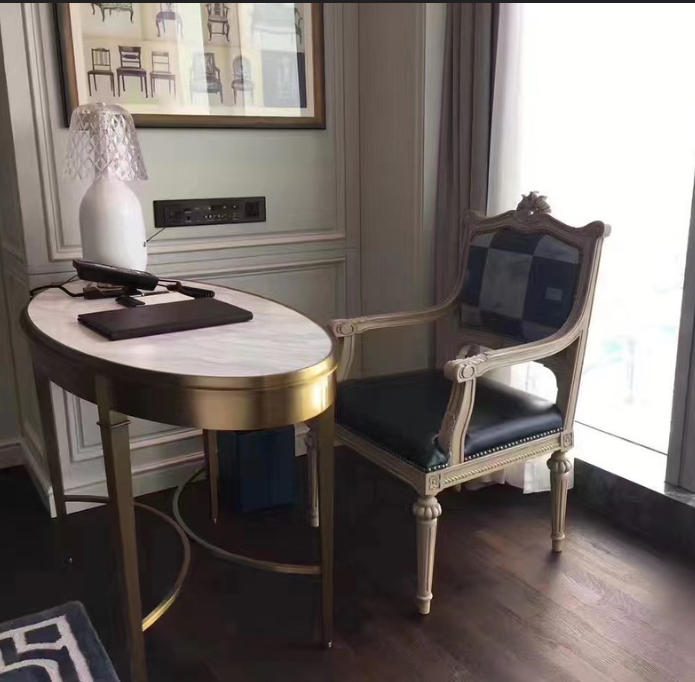
 A completed luxury residential project where the Italian sectional sofa—custom-specified in Sage Bouclé with solid brass legs—became the anchor piece that determined every other material decision in the room.
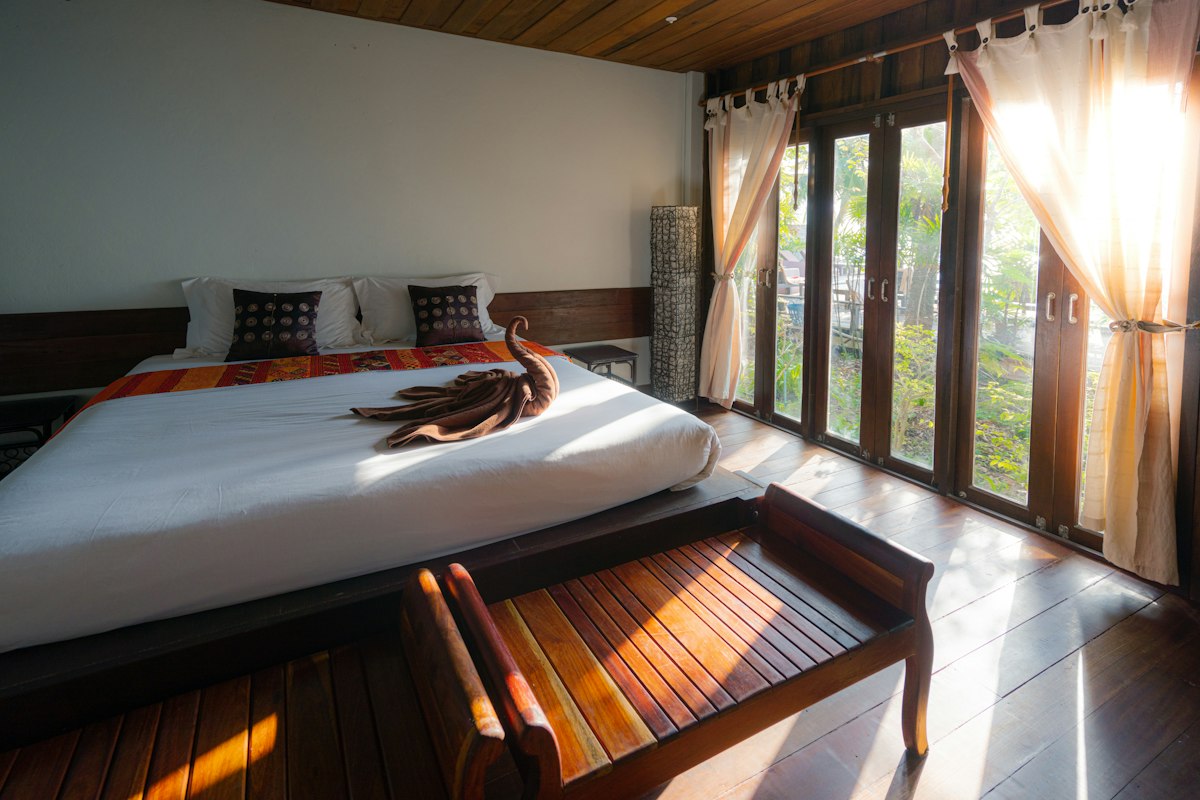 A hospitality lobby specification anchored by a custom-curved Italian seating system. The velvet is contract-grade (80,000+ Martindale rating); the dimensions were specified to fill the circular floor plan exactly. Standard catalog configurations couldn’t solve this brief.
 A curated showroom floor where three Italian brand displays and a dozen material sample stations do more selling than a 200-piece catalog. The curation is the value.
 A luxury residential dining specification: solid marble dining table custom-cut to dimension, full-grain leather chairs with hand-stitched contrast piping. The entire specification sourced through a single Italian manufacturer relationship built over three years.